
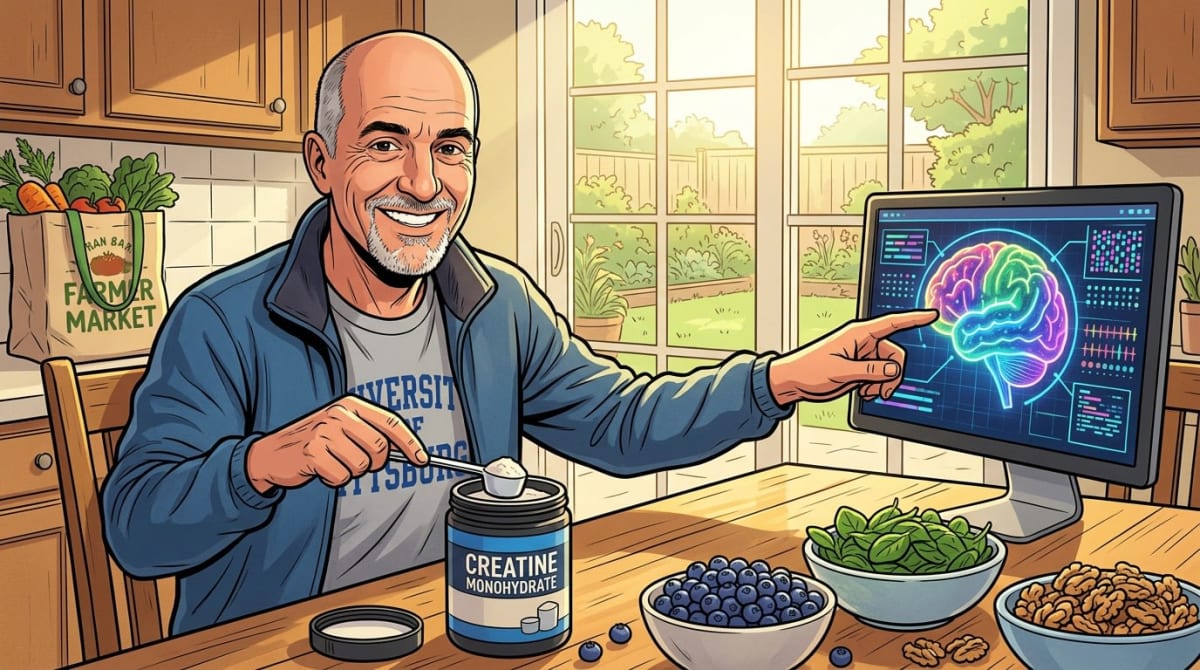
Creatine Is Not Just for the Gym: What the Research Says About Your Brain
The Short Version
- Despite being only 2% of body weight, the brain consumes roughly 20% of the body's resting energy — and creatine is one of the key molecules it uses to regenerate that energy rapidly under demand.
- A 2023 meta-analysis of 22 studies found consistent improvements in working memory and short-term memory from creatine supplementation, with the largest effects in people who started with lower baseline stores.
- Women have approximately 70 to 80 percent of men's creatine stores, and declining estrogen through menopause likely lowers that further — making creatine one of the most under-studied supplements in women's health.
- 3 to 5 grams of creatine monohydrate daily is the evidence-backed dose for cognitive benefits — no loading phase, no special timing, and no reason to choose a more expensive form over plain monohydrate.
- People with pre-existing kidney disease should consult a physician first; for healthy adults, creatine has an excellent safety record across decades of research and is not associated with organ damage at normal doses.
The tub of creatine monohydrate has lived on gym shelves for decades with a clear identity: the thing athletes take. If you've thought about it at all, it's probably in that context — big scoops, big lifts, gains measured in the mirror. Which makes it easy to miss what's been building quietly in the research: creatine isn't primarily a muscle supplement. It's an energy molecule. Your brain runs on it. And for many people — particularly women, vegetarians, and adults over 50 — the brain's creatine supply may be lower than it needs to be.
That's worth knowing. Because what the research is showing about creatine and cognitive function is genuinely interesting, and it belongs in a wider conversation than sports nutrition has been having.
What Creatine Actually Does in the Body
What Creatine Actually Does in the Body
Creatine is a compound your body synthesizes from three amino acids — arginine, glycine, and methionine — primarily in the liver and kidneys. Once made, it travels to tissues that have high and rapid energy demands. Muscles, yes. But also the heart, and the brain.
The mechanism is straightforward: cells need energy in the form of ATP (adenosine triphosphate) to do essentially anything. When ATP gets used, it becomes ADP — a lower-energy molecule. Creatine phosphate donates a phosphate group to convert ADP back into ATP almost instantly. That's the whole story. Creatine is a rapid energy buffer. It doesn't generate ATP from scratch; it helps recycle it at speed when demand spikes.
Your muscles need this for explosive effort. Your brain needs it too. Despite making up only about 2% of your body weight, the brain consumes roughly 20% of your resting energy — running expensive processes continuously: maintaining electrical gradients across billions of neurons, clearing metabolic waste, forming memories, regulating mood and attention. The creatine-phosphate system is one of the mechanisms the brain draws on when energy demand surges — during focused work, during stress, during anything cognitively demanding.
Here is where the body allocates its resting energy, and where the brain fits in that picture:
The body produces about 1 to 2 grams of creatine per day on its own. Meat and fish provide another 1 to 2 grams for people who eat them regularly. vegetarians and vegans, who get little or no dietary creatine, consistently show measurably lower creatine stores — and likely lower brain creatine as well. This isn't a criticism of plant-based eating. It's simply a fact about where creatine comes from and who replenishes it easily.
What would it mean for someone who has been running a mild brain-energy deficit for years to simply close that gap?
The Cognitive Performance Evidence

The Cognitive Performance Evidence
The landmark study is still the 2003 paper by Rae and colleagues, published in the Proceedings of the Royal Society. It was a double-blind, placebo-controlled crossover trial in 45 young adult vegetarians. After six weeks of 5 grams of creatine daily, participants showed significant improvements in working memory — measured by backward digit span — and fluid intelligence, measured by Raven's progressive matrices. The effect was clearest in people whose creatine stores were lower to begin with.
That finding has been refined and replicated. A 2018 meta-analysis in Experimental Gerontology reviewed six studies and found that creatine supplementation improved memory performance, with effects that were more pronounced in older adults. A 2023 systematic review by Prokopidis and colleagues in Nutrition Reviews analyzed 22 studies and found consistent improvements in short-term and working memory across populations.
The important nuance: creatine cognitive function benefits are most meaningful under conditions of brain energy stress — sleep deprivation, mental fatigue, aging, or lower baseline creatine stores. In well-rested younger adults with full stores, the effects are modest. This supplement isn't a nootropic in the way that term is sometimes marketed. It's restoring a capacity that was already constrained. That's a quieter kind of useful — and it may be more real.
Here is how cognitive domains respond to creatine supplementation, based on the weight of meta-analytic evidence:
An effect size of 0.43 means the average person supplementing creatine performs better on working memory tasks than about 67% of non-supplementing people. Not a transformation — a consistent, meaningful edge, particularly for people who needed it most.
Creatine and Aging

Creatine and Aging
This is where the evidence becomes harder to set aside. Creatine synthesis in the body naturally declines with age. Dietary creatine intake often decreases too, as older adults shift toward lighter eating patterns. The gap between what the body makes and what the brain needs widens — gradually, invisibly — over decades.
A 2021 review in Nutrients summarizing research on older adults found that creatine supplementation improved not just physical function and muscle preservation but cognitive performance — particularly memory and executive function. The dual benefit matters here. The same supplement that helps an older adult maintain muscle mass also supports the energy metabolism that brain cells depend on.
Here is how estimated daily creatine availability tends to shift across the lifespan, combining endogenous synthesis and typical dietary intake:
There is also emerging research on neuroprotection. Early trials and animal models have explored creatine's potential role in supporting neural resilience against conditions linked to mitochondrial dysfunction and energy failure in neurons — including Parkinson's and Huntington's disease. The research is early and not yet practice-changing. But the underlying mechanism is credible: creatine doesn't just fuel the brain; it may help protect neurons from the kind of energy failure that precedes cell death. That thread is worth watching.
The body manages. It always manages. The question is whether "manages" is the ceiling worth accepting.
Creatine for Women: The Overlooked Research

Creatine for Women: The Overlooked Research
The research here is both genuinely exciting and genuinely incomplete — and naming that incompleteness is part of the story. For decades, most creatine studies enrolled predominantly or exclusively male participants. What we know about creatine for women is built on a smaller evidence base. What that base shows, though, is compelling.
Women naturally have lower total creatine stores than men — roughly 70 to 80 percent of men's baseline. The reason appears to be hormonal: estrogen influences multiple enzymes in the creatine synthesis pathway. Which means estrogen decline through perimenopause and menopause likely lowers creatine availability further, at exactly the time many women report increased brain fog, word-finding difficulties, and cognitive changes they can't quite explain.
A 2021 review by Smith-Ryan and colleagues in the Journal of Applied Physiology made this case directly: creatine supplementation for women is under-researched and under-utilized, and the hormonal fluctuations across a woman's lifespan create specific creatine deficits that supplementation could address.
There is also preliminary research on mood. Early trials have found associations between creatine and depression, with one small study showing that women with treatment-resistant depression had better antidepressant response when creatine was added to their protocol. The mechanism again traces back to energy: brain regions involved in mood regulation are among the most energy-intensive, and brain bioenergetics are measurably dysregulated in depression.
This isn't a standalone treatment for depression. But it is a thread worth following — and for creatine menopause research specifically, we are likely still in the early chapters.
What gifts might be available to the people in those lower bars — if they simply knew to look?
How to Actually Take It

How to Actually Take It
Creatine monohydrate is the most studied form of creatine by a wide margin, and it is also the most affordable. Every variant on the market — creatine HCl, buffered creatine, ethyl ester — has been tested against monohydrate, and none has consistently outperformed it. The International Society of Sports Nutrition has a clear position: monohydrate is the gold standard.
Dosing for cognitive purposes is the same as for athletic use: 3 to 5 grams per day. No loading phase is needed. The classic loading protocol — 20 grams per day for five to seven days — reaches full tissue saturation faster but arrives at the same destination as a consistent 3 to 5 grams per day within about four weeks. For most people supplementing for brain health rather than athletic performance, there's no urgency that warrants the potential gastrointestinal discomfort of loading.
For creatine ATP brain benefits, timing barely matters. There is some evidence that taking creatine near resistance training improves muscle outcomes, but for cognitive benefits, when you take your daily dose is largely irrelevant. Take it when you'll remember — with breakfast, in coffee, dissolved in a smoothie or glass of water. Creatine monohydrate is flavorless and dissolves easily.
One note worth mentioning: creatine causes the body to retain some water, primarily in muscle tissue. This is not a side effect so much as the mechanism — the creatine-phosphate system in muscle draws water in. Most people notice nothing. Some notice a small shift on the scale. It is not fat gain, and it resolves quickly if supplementation stops.
Who Should and Shouldn't Consider Creatine

Who Should and Shouldn't Consider Creatine
Creatine is among the most studied supplements in existence. The safety profile across decades of research is excellent. For healthy adults, consistent supplementation has not been shown to damage kidneys, liver, or any other organ — including at doses well above the 3 to 5 gram range.
The one meaningful contraindication: people with existing kidney disease. The kidneys are involved in creatine metabolism, and impaired kidney function warrants a physician conversation before adding supplemental creatine. This is a specific, real caution — not a blanket warning for everyone.
Who has the most to gain? The convergence of evidence points clearly:
Older adults — particularly those over 50 — have declining natural synthesis, often declining dietary creatine intake, and demonstrated cognitive and physical benefit from supplementation. Vegetarians and vegans are close behind: the Rae study's largest effects appeared in people who started with lower creatine stores, which is exactly this group. Women navigating perimenopause or post-menopause represent an emerging category — the research base is still growing, but the biological rationale is sound and the gap in the existing literature is being actively closed.
For adults under 35 who eat meat regularly and sleep well, the cognitive benefit from creatine is probably modest. Not zero — but maintenance rather than enhancement.
What creatine is not, and probably won't become, is a standalone treatment for Alzheimer's or Parkinson's disease. The research exploring those connections exists and deserves attention. But making that leap now would outrun the evidence considerably. The more honest framing — and the more useful one — is that creatine supports brain energy metabolism. In people whose brain energy is constrained by age, diet, or hormonal changes, that support may matter more than they realize.
The question isn't whether creatine can fix something that's broken. It's whether the brain you already have gets to work with a full energy budget. For a meaningful number of people, the answer to that question is currently no — not because anything is wrong with them, but because no one ever told them to look.
Content ID: xIhVtfc7rXiDqxpETY1hDG9T
See an error? Tell us.
Keep Reading

What North Carolina's New Food Is Medicine Coalition Reveals About Building State Coalitions from Scratch

What the New FIMC Multi-State Evidence Report Reveals About FIM Cost Savings — and Why High-Acuity Patients Are the Key

Child Care Is the Largest Untapped FIM Delivery Platform — A New Report Shows What's Missing
Comments
Share with the Community