

Fructose and Metabolism: What New Research Found (And the Foods to Swap First)
The Short Version
- A May 2026 Nature Metabolism study found fructose acts as an active metabolic signal — it promotes fat production in the liver, depletes cellular energy, and triggers inflammation pathways that glucose does not.
- Nearly 90% of dietary fructose is processed by the liver on the first pass, compared to roughly 20% of glucose — which is why the form and context of fructose matter far more than the total grams on a label.
- Agave syrup is 85% fructose by composition — higher than high-fructose corn syrup — yet sits in most wellness aisles marketed as a natural low-glycemic sweetener; the glycemic index claim is accurate but deeply incomplete.
- The fiber in whole fruit changes the metabolic response to fructose significantly; eating an apple is a genuinely different metabolic event from drinking 8oz of apple juice, even though fructose content is similar.
- Eliminating sweetened beverages is the single highest-impact change — one can of regular soda delivers more added fructose than most people consume in everything else they eat in a day combined.
For most of the last two decades, the conversation about sugar centered on quantity. Total grams, total calories, the number on the label. Fructose got lumped in with everything else — just sugar, just more of what to limit. A study published in Nature Metabolism in May 2026 by researchers at the University of Colorado Anschutz Medical Campus shifts that framing significantly. Fructose, the research shows, is not behaving like a neutral calorie source. It is behaving like a metabolic signal — actively promoting fat storage, depleting cellular energy, and triggering effects that glucose simply does not.
The practical upshot is encouraging. The changes that matter most here are not about eating less fruit or counting grams obsessively. They are about reading a handful of labels and swapping a few products most of us reach for on autopilot. If you already eat mostly whole foods, you are probably ahead of most of this conversation already — and this research gives you a cleaner explanation for choices you may already be making intuitively.
Why Fructose Is Different From Other Sugars
Why Fructose Is Different From Other Sugars
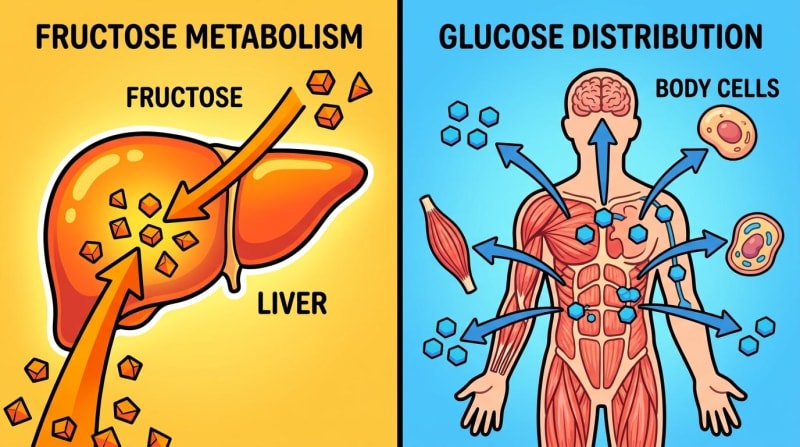
Fructose and glucose have the same chemical formula and the same caloric value — 4 calories per gram. On a nutrition label, they are indistinguishable. But inside the body, they take completely different paths.
Glucose enters the bloodstream and triggers insulin, signaling cells throughout the body to take it up for energy. The system has natural governors: when blood glucose rises, feedback mechanisms slow further processing. Fructose largely bypasses those governors. It is metabolized almost entirely in the liver, where it enters the fat-production pathway — de novo lipogenesis — with far fewer checkpoints. This is not a calorie argument; it is a pathway argument. Same fuel, very different furnace.
Here is how the fructose content of common sweeteners compares, based on USDA nutrient composition data:
Agave's position at the top of that chart is worth a pause. It is frequently marketed as a natural, low-glycemic alternative to refined sugar — and the low glycemic index claim is technically accurate, because fructose does not spike blood glucose the way glucose does. What that framing quietly omits is that a lower blood sugar spike is not the same as less metabolic impact. The fructose and metabolism story is not a glycemic index story.
One additional layer the University of Colorado research highlights: the body can generate fructose internally from glucose through a process called the polyol pathway. Even someone eating no added fructose can produce it internally when glucose intake is consistently high. Dietary fructose remains the biggest lever to pull, but endogenous production helps explain why metabolic dysfunction can develop in people whose food labels look perfectly reasonable.
What is not the story here? Fruit. An apple delivers fructose, yes — but it delivers it wrapped in fiber that slows absorption, alongside water, vitamins, and minerals. The metabolic response to eating a whole apple is genuinely different from drinking the same amount of fructose from a bottle. That distinction threads through every section below.
What the New 2026 Research Found

What the New 2026 Research Found
The central finding from Johnson et al., Nature Metabolism, May 2026 reframes fructose from passive calorie to active metabolic signal. Lead researcher Richard Johnson, MD stated it directly:
"Fructose is not just another calorie. It acts as a metabolic signal that promotes fat production and storage."
— Richard Johnson, MD, University of Colorado Anschutz, Nature Metabolism 2026
The specific mechanisms the research identified: fructose increases hepatic de novo lipogenesis (fat production in the liver), reduces cellular ATP — the body's primary energy currency — and generates compounds including uric acid associated with metabolic syndrome, inflammation, and cardiovascular risk. The ATP reduction matters more than it might initially appear. When cells have less usable energy, the body may signal hunger even in a caloric surplus. That can produce a cycle of eating more while storing more — not a discipline problem, but a biochemical one that fructose and metabolism researchers can now describe in precise terms.
The reason fructose hits the liver so hard is structural. Research on first-pass sugar metabolism consistently shows that nearly all dietary fructose is processed by the liver before reaching other tissues, compared to a much smaller fraction of glucose, which distributes across muscles, brain, and other tissues directly:
A companion study published in Acta Physiologica (April 2026) provided mechanistic confirmation. When researchers blocked the KHK enzyme — the liver's primary fructose-processing tool — in mice on a high-fructose diet, the animals were protected from metabolic dysfunction. Not just improved — protected. The calories were identical; removing the specific processing pathway made the difference. That is strong evidence that the metabolic effects of fructose trace to the pathway it activates, not to any caloric math.
For people already eating mostly whole, minimally processed foods, this research offers confirmation of something many have noticed intuitively: foods sweetened with high-fructose corn syrup register differently in the body than whole-food sweetness does. The science now has a more specific explanation for why.
Where Fructose Actually Hides in Everyday Eating

Where Fructose Actually Hides in Everyday Eating
Most of the fructose burden in a typical diet does not come from obvious sweets. It concentrates in condiments, flavored dairy, packaged breads, and beverages that feel incidental rather than indulgent. Here is where it actually shows up, in grams per serving, based on USDA nutrient database values:
The whole apple sits at roughly 11 grams — but it arrives with fiber that meaningfully slows absorption and changes the metabolic response. The comparison between the apple and 8 ounces of apple juice is one of the clearest illustrations of the fiber-buffer effect: similar fructose content, genuinely different metabolic pathway. Research on dietary fiber and fructose absorption consistently finds that intact fiber slows fructose uptake and reduces the liver's de novo lipogenesis response. Juice removes that buffer entirely.
High-fructose corn syrup appears on ingredient lists under several names. The FDA's ingredient guidance recognizes corn syrup, corn sweetener, glucose-fructose syrup, and isoglucose as names that may indicate the same or closely related ingredients. On packaging, these appear most reliably in: ketchup and barbecue sauce, commercial salad dressings, flavored yogurts, soft commercial breads and rolls, and sweetened beverages including sports drinks and flavored waters.
Agave syrup warrants its own mention. At 70–90% fructose by composition — higher than high-fructose corn syrup — it is one of the most concentrated fructose sources available, sitting in the wellness aisle next to raw honey and coconut sugar. The marketing language around agave syrup health claims is genuinely misleading, and this is one of the clearest cases where the label story and the hidden fructose in food story diverge completely.
What would it look like to give those automatic-reach products a closer read — just once, just the labels on the items you buy most regularly? The information is already on the package.
Practical Swaps That Move the Needle

Practical Swaps That Move the Needle
Reducing fructose intake does not require overhauling a kitchen. The highest-impact changes are also the most concrete. Here is how the five most useful swaps compare in terms of added fructose eliminated per serving:
Plain Greek yogurt with fresh fruit is arguably the most satisfying of these swaps because you lose nothing. You still get the fruit, you still get the creaminess, you get more protein, and you eliminate the hidden fructose in one move. Flavored yogurt commonly carries 15–20 grams of added sugar per cup, roughly half from fructose. The plain version with a handful of berries delivers the same eating experience with a genuinely different metabolic profile.
Whole fruit instead of juice matters especially for people who drink juice as a daily health habit. The fiber in whole fruit slows fructose absorption significantly — and nutrition research on fiber and fructose metabolism consistently finds that fructose consumed with intact fiber produces a meaningfully lower liver fat response than the same fructose in liquid form. This is not a fruit-avoidance argument; it is a form argument.
Replacing agave in smoothies, cooking, or coffee with a small amount of maple syrup or raw honey gives you a lower-fructose sweetener with actual micronutrient content — manganese and zinc in maple syrup, trace enzymes and minerals in raw honey. Neither is a health supplement in large quantities, but the fructose math is meaningfully better than agave at equivalent volumes, and neither carries the misleading low-glycemic marketing.
Condiment label reading is a one-time investment that compounds forward. Many households have had the same bottle of ketchup for years without ever checking the ingredients. A version sweetened with cane sugar or no sweetener at all is the same product in every other way — and once the swap is made, it persists. The same applies to barbecue sauce and teriyaki, which carry the most concentrated per-tablespoon HFCS exposure of most condiment categories.
The easiest entry point if all of this feels like a lot: beverages. A single can of regular soda delivers more added fructose than most people consume in everything else combined in a day. Eliminating or significantly reducing sweetened beverages — including juice — addresses more of the fructose burden for most people than any other single change.
What This Means If You Are Already Eating Mostly Whole Foods

What This Means If You Are Already Eating Mostly Whole Foods
For people building their diet around vegetables, whole grains, legumes, and fruit — with occasional treats but no daily sweetened beverages — this research is confirmation, not an alarm. The metabolic syndrome diet risk from fructose concentrates in people consuming high volumes of added fructose in liquid form, consistently, without fiber or the broader nutritional context of a whole-foods pattern. That is a specific profile, and most people reading this carefully are probably not in it.
The University of Colorado research is not a natural fructose vs added fructose scare. It is not a sugar-free argument. It is a specific finding about a specific pathway — and the practical footprint of that finding is narrower than most headlines suggest. Dose matters. Form matters. Context matters. A mango is not a can of soda. An apple is not a cup of flavored yogurt sweetened with corn syrup.
What the research does provide is a cleaner mechanistic story for something many whole-foods eaters have already noticed: processed foods sweetened with HFCS register differently in the body than whole-food sweetness does. That is not imagination, and now there is a more precise explanation for why it traces to the pathway fructose activates in the liver — not to sugar quantity alone.
The metabolic syndrome diet conversation, at its most useful, is not primarily about restriction. It is about recognizing that some of the sweetness in your kitchen is doing something biochemically distinct from other sweetness — and that once you know which products those are, the swaps are genuinely simple.
If you already eat mostly real food, somewhere in your kitchen is probably one product where the label story and the biochemistry story quietly diverge. What is it — and is the swap worth making?
Content ID: uX0nmX9HqzLBEoR2xyYaZqKj
See an error? Tell us.
Keep Reading

What North Carolina's New Food Is Medicine Coalition Reveals About Building State Coalitions from Scratch

What the New FIMC Multi-State Evidence Report Reveals About FIM Cost Savings — and Why High-Acuity Patients Are the Key

Child Care Is the Largest Untapped FIM Delivery Platform — A New Report Shows What's Missing
Comments
Share with the Community