The Only Workout That Let Older Adults Lose Fat Without Losing Muscle, According to New Research
The Short Version
- A June 2026 controlled trial of 120+ adults in their 70s found that HIIT was the only exercise type to reduce body fat while simultaneously preserving muscle mass — moderate cardio and walking didn't achieve both.
- Sarcopenia, the age-related loss of muscle, affects an estimated 10-40% of older adults and accelerates after 60, making muscle preservation during fat loss far more medically significant than aesthetics alone.
- The mechanism is hormonal: HIIT triggers acute spikes in growth hormone and catecholamines that signal the body to protect lean tissue — a response that sustained moderate exercise simply doesn't produce.
- HIIT for someone in their 70s can mean a stationary bike or pool walking — 20-30 second hard intervals, 40-60 seconds of recovery, repeated 8-10 times, with a total session under 30 minutes.
- Protein intake of at least 1.2g per kilogram of body weight daily amplifies the muscle-preservation effect; eggs, Greek yogurt, salmon, and legumes are the practical anchors around training days.
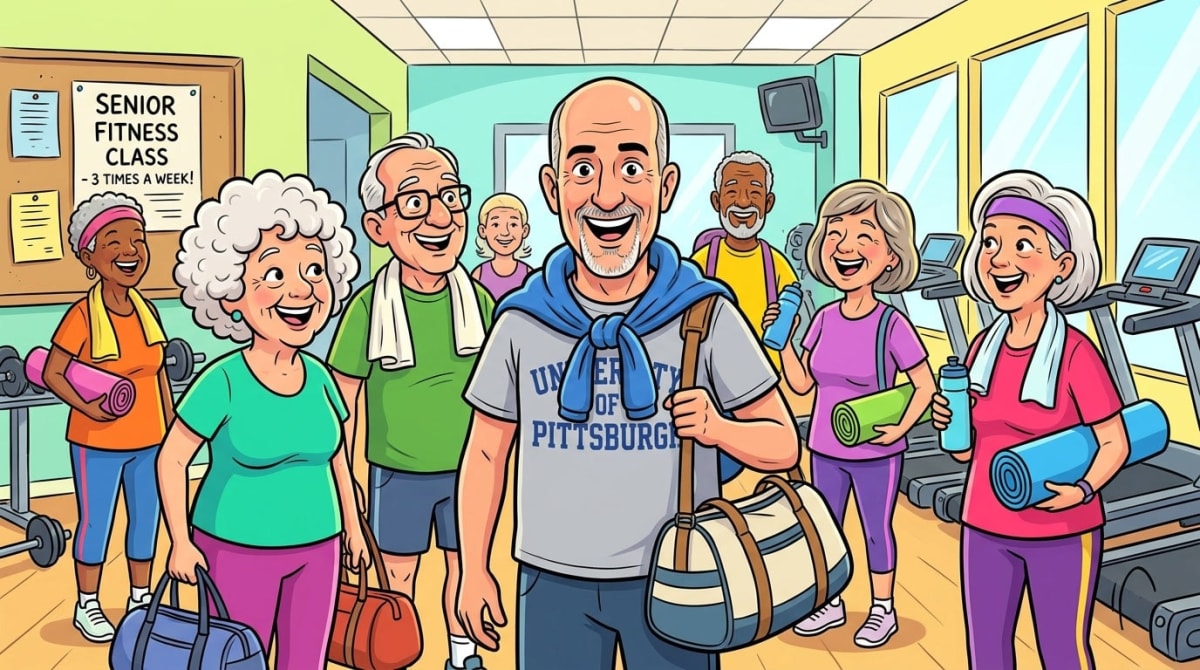
Picture three groups of people in their seventies, each showing up to exercise three times a week for six months. Same age range. Same consistency. Researchers tracked what happened to their body fat and muscle mass over that time. Two of the groups — those doing moderate continuous exercise and those in the control group — didn't achieve what the researchers were measuring for. The third group did.
That group was doing high-intensity interval training.
The findings, published June 28, 2026 and summarized by ScienceDaily, come from one of the larger controlled exercise trials specifically conducted in adults over 70, involving more than 120 participants. HIIT for older adults fat loss achieved what the other approaches didn't — it reduced body fat while simultaneously preserving muscle mass. Moderate continuous exercise didn't produce this combined effect. The control group didn't either.
That dual outcome isn't just an aesthetic win. For adults in their seventies, it's the most consequential combination in exercise science right now — because losing fat and losing muscle at the same time is a trade most people can't afford to make.
What the New Study Found: HIIT vs. Moderate Exercise vs. Walking
What the New Study Found: HIIT vs. Moderate Exercise vs. Walking
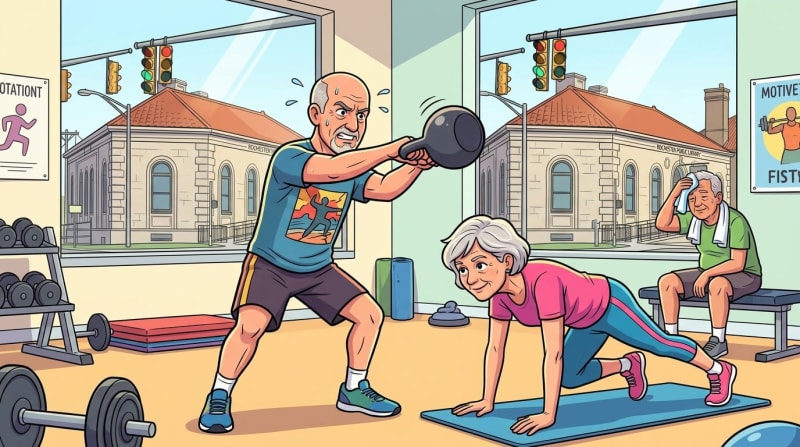
The study's setup was carefully controlled: more than 120 adults in their 70s, divided into three groups — high-intensity interval training, moderate continuous exercise (sustained walking or steady cycling), and a control group maintaining their normal activity level. Over six months, researchers measured changes in body fat and muscle mass through objective assessments.
As ScienceDaily reported, only the HIIT group hit both targets simultaneously:
"High-intensity interval training may offer a key advantage over other forms of exercise: it helped reduce body fat while preserving valuable muscle mass."
— ScienceDaily summary of study, June 28, 2026
The moderate exercise group did not show the same dual effect. Neither did the control group.
The scale of this trial matters. Studies of exercise interventions in adults specifically over 70 are uncommon at this sample size. This is one of the larger controlled comparisons ever conducted in this age group, which gives the finding more credibility than a smaller pilot study would carry.
Here is how each approach compared on achieving both study goals at once:
What makes this finding stand out is not just what HIIT accomplished — it's what the alternative approaches didn't. Moderate exercise, the kind most often recommended for older adults, didn't move the needle on both measures simultaneously. That's worth sitting with before accepting the conventional wisdom about what older bodies need.
Why Losing Muscle Is Such a Problem After 60 — and Why Most Exercise Makes It Worse
Why Losing Muscle Is Such a Problem After 60 — and Why Most Exercise Makes It Worse
The clinical term is sarcopenia — the progressive loss of muscle mass and strength that accelerates after the age of 60. According to Harvard's Nutrition Source, sarcopenia affects an estimated 10 to 40 percent of older adults and is associated with increased mortality, falls, and metabolic dysfunction.
Those numbers deserve a moment. This isn't a niche concern for people already dealing with frailty. Sarcopenia develops quietly, over years, even in people who consider themselves active — and the research shows it accelerates significantly through the seventies and beyond.
Here's the difficulty: the traditional approach to losing body fat — sustained moderate cardio — can quietly worsen the sarcopenia problem. Steady-state cardio creates a calorie deficit, which the body partially meets by breaking down muscle tissue for fuel. In older adults, who are already less efficient at protein synthesis and muscle repair than they were at 40, this muscle breakdown during a calorie deficit is more pronounced than most people realize.
So the advice that feels most intuitive — "just walk more" — isn't wrong exactly. Walking is genuinely good for cardiovascular health, joint mobility, and mood. But if the goal includes holding onto muscle while reducing fat, walking alone doesn't give the body the signal it needs to protect lean tissue. In fact, long moderate cardio sessions may actively work against that goal by keeping cortisol elevated and pulling from muscle stores as readily as fat.
What does this mean for someone who has been logging 45-minute cardio sessions and wondering why the results aren't matching the effort?
What Makes HIIT Different: The Hormonal Mechanism

What Makes HIIT Different: The Hormonal Mechanism
The difference between HIIT and moderate exercise isn't just a question of intensity — it's about the hormonal environment the exercise creates in the body. According to Examine.com's evidence-based exercise research, HIIT triggers acute elevations in growth hormone and catecholamines that moderate continuous exercise simply does not produce. This hormonal spike is brief — it peaks in the minutes immediately after the high-intensity intervals — but its effect on body composition is significant.
Growth hormone and catecholamines signal the body to protect and repair lean tissue. That anabolic window appears to counteract the catabolic pressure that would otherwise accompany a calorie deficit. In plainer terms: the intensity tells the body that muscle is being actively used and is therefore necessary, so the body defends it even as fat stores decrease.
Duration matters too. Long moderate-intensity sessions keep cortisol elevated for extended periods, which can accelerate muscle breakdown over time. HIIT sessions are shorter by design. The intense intervals are brief enough that the hormonal environment doesn't tip into the catabolic state that prolonged moderate exercise can create.
This is the mechanism that makes HIIT for older adults fat loss physiologically distinct — not just harder, but different in how it instructs the body to handle energy and tissue. If the body has always been capable of this hormonal response well into the seventies, what might that mean for what's still possible?
What HIIT Actually Looks Like for Someone in Their 70s: It Is Not What You Think
What HIIT Actually Looks Like for Someone in Their 70s: It Is Not What You Think
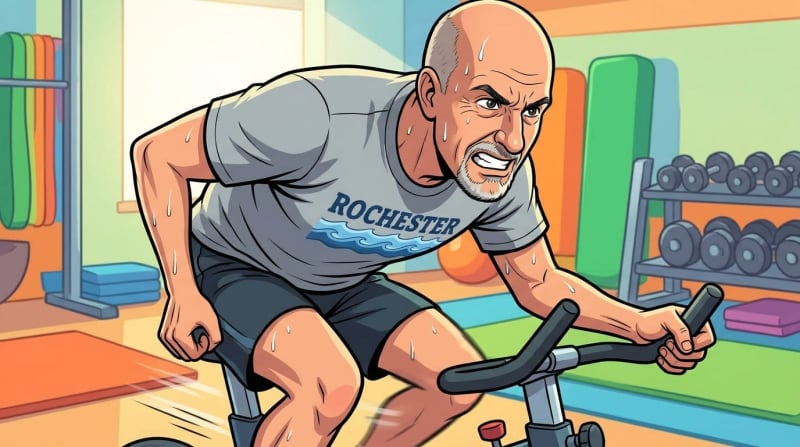
This is the part that changes the conversation. HIIT for adults in their 70s looks nothing like the images the name calls up.
High-intensity is relative — relative to your current capacity, not to a 25-year-old's maximum output. According to Examine.com, low-impact HIIT on a stationary bike or in a pool produces cardiovascular and body composition benefits comparable to higher-impact versions, with significantly lower injury risk in older adults. No sprinting. No jumping. No heavy weights required.
A typical study protocol used 20 to 30 second high-effort intervals, followed by 40 to 60 seconds of lower-intensity recovery, repeated 8 to 10 times per session. The target during intervals: 75 to 85 percent of maximum heart rate. During recovery: 50 to 60 percent. Total session time, including warm-up and cool-down: under 30 minutes.
The practical translation, on a stationary bike: the high-intensity interval is pedaling fast enough that holding a conversation would be uncomfortable. The recovery phase is slow enough that it wouldn't be. Alternating between those two states — "can't talk" to "can talk" — 8 to 10 times, is the protocol. That's the whole structure.
What would it mean to realize that the workout most aligned with your goals is actually shorter than the one you've been doing?
How to Start: Building Your First HIIT Session Safely After 60

How to Start: Building Your First HIIT Session Safely After 60
The starting point is simpler than most people expect. The key is calibrating effort to your current capacity and building gradually — not pushing to maximum intervals on day one.
Start with the stationary bike or pool walking. Both offer lower joint stress than outdoor terrain and give you precise control over effort. On a bike, resistance controls intensity. In the pool, pace and arm engagement do the work. Either gives you the interval structure you need without the injury variables of uneven ground or high-impact movement.
Begin with 4 to 6 intervals per session and stay there for the first three to four weeks. Physiological adaptation happens between sessions — during recovery — not during the session itself. Four consistent intervals twice a week builds a stronger foundation than 10 intervals once a week followed by soreness that keeps you out for days.
Protein intake is part of this equation, and it's where the food picture connects directly to the training. Harvard's Nutrition Source notes that combining exercise with adequate protein — at least 1.2 grams per kilogram of body weight per day — is consistently associated with better muscle preservation outcomes during weight loss in older adults. Active older adults may benefit from pushing toward 1.6 grams per kilogram.
The foods that supply this aren't complicated. Eggs, Greek yogurt, salmon, legumes, cottage cheese — the proteins that feel genuinely satisfying around a meal are often the ones doing the most work here. This isn't about adding powders to drinks you'd rather not finish. It's about building the protein meals you probably already enjoy into the days around your training sessions.
If you have cardiovascular conditions, check with your physician before starting — not because HIIT is inherently dangerous for older adults, but because your individual heart rate targets need to be calibrated to your specific health picture. A cardiologist or sports medicine physician can give you a target range that accounts for medications or conditions that affect how your heart responds to effort.
The research is now clear on the value of the effort. What remains is simply deciding to try — at whatever intensity is genuinely and authentically yours.
Content ID: OIY9NQRmJAmpNUFalEoRgCKB
See an error? Tell us.
Keep Reading
What North Carolina's New Food Is Medicine Coalition Reveals About Building State Coalitions from Scratch

What the New FIMC Multi-State Evidence Report Reveals About FIM Cost Savings — and Why High-Acuity Patients Are the Key

Child Care Is the Largest Untapped FIM Delivery Platform — A New Report Shows What's Missing
Comments
Share with the Community