

Zyrtec vs Claritin vs Allegra: What the Science Actually Says
The Short Version
- Zyrtec, Claritin, and Allegra are closer on symptom relief than the marketing suggests — cetirizine (Zyrtec) tests slightly strongest, while loratadine (Claritin) is the weakest of the three.
- The real difference is drowsiness: brain-imaging shows cetirizine (Zyrtec) occupies up to 25% of brain histamine receptors, while fexofenadine (Allegra) stays almost entirely out of the brain.
- Steroid nasal sprays beat the pills on raw symptom control — roughly 25% reduction versus 5–10% — but only if used correctly every day, which most people don't.
- Large studies since 2015, including a 280,000-person analysis, pin the dementia scare on first-generation Benadryl and a few specific drug classes — not on modern allergy pills.
- In May 2025 the FDA warned that stopping Zyrtec or Xyzal after long-term daily use can trigger severe, sudden itching, so taper rather than quit cold turkey.
My allergies have gotten worse with age. For most of my life, spring in Rochester was something I barely noticed. Now it announces itself — the itchy eyes, the sneezing fits, the foggy mornings. I reached for Zyrtec, and it works. It genuinely shuts the symptoms down. The problem is that it also shuts me down — the drowsiness is real and fairly extreme. That tradeoff is what sent me reading every study I could find on Zyrtec vs Claritin vs Allegra, the three drugs most of us pull off the same pharmacy shelf without much thought.
Here's the good news up front: this is a remarkably well-studied corner of medicine. These three drugs have been compared head-to-head in large randomized trials for decades, and the picture that emerges is clearer than the marketing would suggest. If you've ever stood in that aisle wondering whether the box actually matters, it does — and not always in the way you'd expect.
First, the thing I needed to confirm: am I imagining the age effect? I'm not. A review on allergy and aging in the journal literature describes exactly this — allergic sensitivities can intensify or appear for the first time in midlife, driven by shifting immune patterns, cumulative pollen exposure, and changes in the nasal lining. (Interestingly, in the very elderly the immune system sometimes dials back down, and non-allergic rhinitis becomes more common instead.) So if your hay fever is louder at 55 than it was at 25, you're not imagining it either.
How These Drugs Actually Work
How These Drugs Actually Work
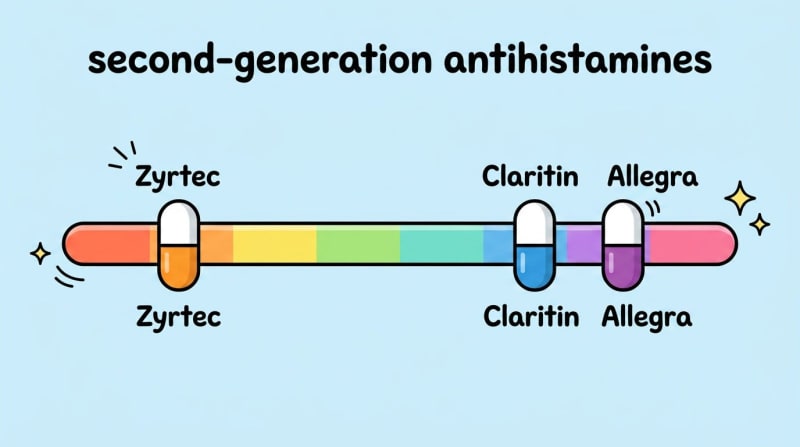
All three are antihistamines, and they all do the same basic job: they block the H1 receptor, the docking site where histamine triggers the sneezing, itching, and runny nose of an allergic reaction. The difference that matters isn't really about which symptom each one fights. It's about where else in the body they go.
The old "first-generation" antihistamines — diphenhydramine (Benadryl), chlorpheniramine (Chlor-Trimeton) — cross the blood-brain barrier easily. That's why they knock you out, and it's the whole reason diphenhydramine (Benadryl) moonlights as a sleep aid. The "second-generation" drugs — cetirizine (Zyrtec), loratadine (Claritin), and fexofenadine (Allegra) — were engineered to stay out of the brain. As the Mayo Clinic Proceedings review of oral antihistamines explains, they're more selective for the H1 receptor and far less likely to penetrate the central nervous system.
That's the theory. What I found is that "second-generation" turns out to be a spectrum, not a category — and the spread within that spectrum is the most useful thing a reader can know.
What the Studies Say: Zyrtec vs Claritin vs Allegra on Effectiveness

What the Studies Say: Zyrtec vs Claritin vs Allegra on Effectiveness
Start with the question everyone actually has: which one works best? On raw symptom relief, the evidence gives a slight edge to cetirizine (Zyrtec). In a pollen-challenge trial of 575 people published in Annals of Allergy, Asthma & Immunology, cetirizine (Zyrtec) reduced symptom scores about 33% more than fexofenadine (Allegra) at the 21-to-24-hour mark, meaning it held its effect longer through the day.
Here is how the symptom reduction compared in that trial:
Before you crown a winner, though, the gap is smaller than it looks. A separate 821-person study in the Journal of Allergy and Clinical Immunology found fexofenadine (Allegra) 180mg statistically equivalent to cetirizine (Zyrtec) across all efficacy measures. The honest summary is that Zyrtec and Allegra are close enough that most people won't feel a meaningful difference in relief.
Claritin is the outlier. A 2023 network meta-analysis pooling many trials concluded that loratadine (Claritin) has inferior efficacy compared with the other modern oral antihistamines. It's not that Claritin doesn't work — it beats placebo — but if pure symptom-crushing power is your only goal, it's the weakest of the three. That surprised me, given how many people I know reach for it first.
So if they're all reasonably effective, what should actually drive the choice? For me, the answer turned out to be the side effect I was already living with.
The Drowsiness Question: Why Zyrtec Knocks Some of Us Out

The Drowsiness Question: Why Zyrtec Knocks Some of Us Out
This is where the three drugs genuinely part ways, and where my own experience lines up almost perfectly with the data. Cetirizine (Zyrtec) is the most sedating of the three — by a wide margin.
The clearest evidence comes from PET brain scans that actually measure how many H1 receptors each drug occupies inside the brain. As summarized in a review of antihistamine somnolence, a standard 10mg dose of cetirizine (Zyrtec) occupied about 12.5% of brain H1 receptors, and a 20mg dose occupied 25.2%. Fexofenadine (Allegra), by contrast, barely registers — it stays almost entirely out of the brain.
Here's that comparison, which is the single most useful chart I built for this piece:
Receptor occupancy isn't an abstraction. It shows up in the real world. A postmarketing surveillance analysis found the risk of drowsiness and sedation was significantly lower for fexofenadine (Allegra) and loratadine (Claritin) than for cetirizine (Zyrtec). An FDA adverse-event database study similarly found cetirizine (Zyrtec) carried stronger signals for nervous-system and psychiatric effects than loratadine (Claritin). And in a driving-simulator review, the old first-generation diphenhydramine (Benadryl) impaired driving as badly as alcohol, while fexofenadine (Allegra) left drivers unaffected — and the Mayo review notes that people sedated by cetirizine (Zyrtec) drove about as poorly as people impaired by alcohol.
The ranking that emerges is consistent: fexofenadine (Allegra) is the least sedating, loratadine (Claritin) is in the middle, and cetirizine (Zyrtec) is the most likely to leave you foggy. If you, like me, find that Zyrtec works beautifully but costs you your afternoon, that's not a quirk. That's the pharmacology.
Which raises a fair question: if one drug controls your symptoms but dims your day, and another is gentler on alertness but slightly less potent — how do you weigh relief against being fully present for your own life?
How They Stack Up Against the Nasal Sprays
How They Stack Up Against the Nasal Sprays
Here's the finding I didn't go looking for but think every allergy sufferer deserves to hear: on raw symptom control, the pills are not the most effective option on the shelf.
A 2024 systematic review and meta-analysis in JACI: In Practice compared intranasal corticosteroids (the steroid nasal sprays like fluticasone (Flonase)) directly against oral antihistamines. The nasal sprays won clearly — better nasal symptom scores, better ocular symptom scores, and a clinically meaningful improvement in quality of life, rated as high-certainty evidence. Put in plainer numbers, a family-practice review found steroid nasal sprays cut total nasal symptoms by roughly 25% over placebo, while oral antihistamines managed only about 5–10%. It's why the major 2020 allergy guidelines favor intranasal steroids as first-line for moderate symptoms.
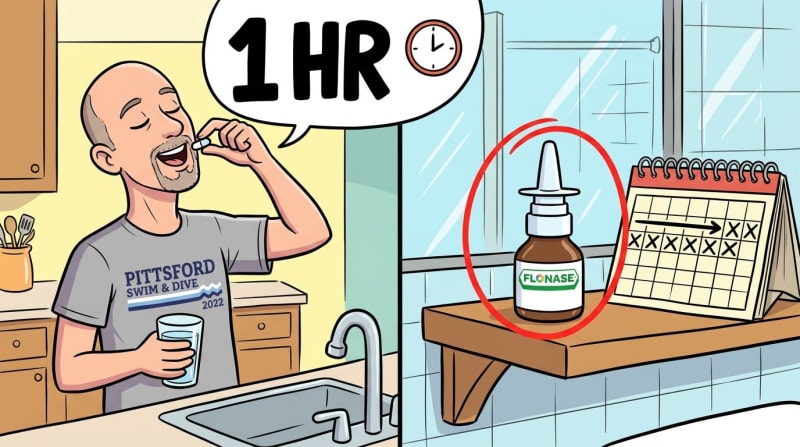
But "more effective in a trial" and "better for you in real life" aren't the same thing, and the sprays carry real tradeoffs the studies don't put on the box. They're slow — a pill can bring relief within an hour, while a steroid spray has to be used every day and takes days to build to its full effect, which is exactly why so many people try one for two days, feel nothing, and give up. They also have local side effects a pill doesn't: a Cochrane review puts nosebleeds at roughly 5–10% and nasal dryness, burning, or stinging at another 5–10%, with bitter taste and headache also common. And they demand technique and consistency — you have to aim and spray correctly, every single day, and real-world adherence to nasal sprays is notoriously poor, which quietly erases much of that efficacy edge for the average person.
So the honest framing isn't "sprays beat pills." It's that the most effective tool is also the most demanding one, and the convenient tool asks less of you but delivers less. If you've been escalating your antihistamine dose every spring wondering why you're still miserable, a nasal spray used properly and daily may be the missing piece. If you know you'll never keep up a daily routine, the pill you'll actually take beats the spray you won't. Which kind of person are you — and have you ever honestly answered that before reaching for a box?
The Long-Term Safety Picture

The Long-Term Safety Picture
When you take a drug every single day for years, the long-term safety question stops being academic. This is where I expected the scariest findings, and where the truth turned out to be genuinely reassuring — with one important distinction the headlines tend to flatten.
You may have seen alarming stories linking antihistamines to dementia. They trace back to a real and rigorous study: Gray and colleagues in JAMA Internal Medicine in 2015, which followed more than 3,400 older adults for over seven years and found that heavy cumulative use of strongly anticholinergic drugs was associated with higher dementia risk, in a dose-dependent way. Here is the distinction that matters enormously: the antihistamines in that signal were first-generation drugs — diphenhydramine (Benadryl) and chlorpheniramine (Chlor-Trimeton) — not the three on our shelf. In fact, the study's own authors recommended switching to a second-generation antihistamine like loratadine (Claritin) as the safer alternative.
That study is now a decade old, so the obvious question is what the research has found since — and quite a lot, all pointing the same direction. The largest follow-up, Coupland and colleagues in JAMA Internal Medicine in 2019, examined roughly 280,000 British patients and again found about a 50% increase in dementia risk with heavy anticholinergic use. But because it was so large, it could separate the drug classes — and the elevated risk was concentrated in specific ones: antidepressants, bladder antimuscarinics, antipsychotics, antiparkinson and antiepileptic drugs. Antihistamines were notably not among the classes driving the association. A 2024 laboratory study using lab-grown human neurons from a long-running aging cohort found the same split at the cellular level: antidepressants and bladder drugs damaged the neurons, while antihistamines did not.
One more piece of honesty about all of this: a 2024 umbrella review of 68 meta-analyses stresses that nearly all of this evidence is observational. That means it can show association but not prove cause, and it's vulnerable to a quirk called confounding by indication — the early, undiagnosed stages of dementia might cause more prescriptions rather than the other way around, which is why careful studies now throw out the final year of prescriptions before a diagnosis. So the dementia link is real, worth taking seriously, and concentrated in a handful of strongly anticholinergic drug classes that don't include modern allergy pills.
The dementia worry belongs to Benadryl and a few specific drug classes — not to Zyrtec, Claritin, or Allegra.
The other historical fear was cardiac. Two early "non-drowsy" antihistamines, terfenadine (Seldane) and astemizole (Hismanal), were pulled from the market for causing dangerous heart-rhythm problems. The Mayo Clinic Proceedings review is clear that loratadine (Claritin), cetirizine (Zyrtec), and fexofenadine (Allegra) have shown no clinically meaningful cardiac effects, even at high doses. Fexofenadine (Allegra) is actually the safe, redesigned successor to terfenadine (Seldane) — same allergy relief, without the heart risk. After decades on the market and billions of doses, the long-term safety record of these three is strong.
The Withdrawal Itch Nobody Warned You About

The Withdrawal Itch Nobody Warned You About
There's one new development that wasn't on anyone's radar until recently, and it's the single most useful thing I can pass along. In May 2025, the FDA issued a formal warning: people who stop taking cetirizine (Zyrtec) or levocetirizine (Xyzal) after long-term daily use can develop severe, widespread itching within a few days.
The agency identified 209 cases reported between 2017 and 2023. The breakdown points squarely at cetirizine (Zyrtec):
A few details worth holding onto. The risk rises the longer you've been taking it — some people in the reports had used it daily for years. The itching typically starts one to five days after stopping. Restarting the drug usually resolves it, and a 2026 scoping review found that tapering off slowly, rather than quitting cold turkey, appears to help. Critically, this effect seems specific to cetirizine (Zyrtec) and levocetirizine (Xyzal) — it has not been reported for loratadine (Claritin) or fexofenadine (Allegra).
I want to be careful here, because this is exactly the kind of finding that can spook someone into doing something rash: if you take Zyrtec daily and want to stop, this is a conversation to have with your doctor or pharmacist about tapering, not a reason to panic or to white-knuckle through. I'm a fellow allergy sufferer who reads a lot of studies, not your physician — and the whole point of knowing this is to stop thoughtfully, not abruptly.
So What Should You Actually Take?

So What Should You Actually Take?
After all of it, here's what I carry out of the research — offered as a fellow traveler, not a prescriber.
The three drugs are more alike than different on relief, with cetirizine (Zyrtec) slightly strongest, fexofenadine (Allegra) close behind, and loratadine (Claritin) the gentlest performer. The real decision is the tradeoff I live with personally: cetirizine (Zyrtec) gives the most reliable relief but is the most sedating, fexofenadine (Allegra) gives nearly the same relief with the least drowsiness, and loratadine (Claritin) sits in the middle on both. If daytime alertness matters to you — if you drive, fly, foil, or just want your afternoons back — fexofenadine (Allegra) is the one the evidence quietly points toward. If a stuffy nose is your worst symptom, the steroid nasal spray may serve you better than any pill. And whatever you take daily, taper rather than quit.
What strikes me most, reading all of this, is how much good science is sitting just behind those identical-looking boxes — and how little of it ever reaches the person standing in the aisle. You don't need a medical degree to make a smarter choice here. You just need someone to hand you the evidence.
So I'll hand it to you, and turn it back into a question worth sitting with: now that you know what's actually inside the box, what would your best tradeoff be — and have you ever really chosen it on purpose?
Content ID: LFAKMLD6xUIZSJbvImM7D984
See an error? Tell us.
Keep Reading

What North Carolina's New Food Is Medicine Coalition Reveals About Building State Coalitions from Scratch

What the New FIMC Multi-State Evidence Report Reveals About FIM Cost Savings — and Why High-Acuity Patients Are the Key

Child Care Is the Largest Untapped FIM Delivery Platform — A New Report Shows What's Missing
Comments
Share with the Community