

Seed Oils and Inflammation: What the Research Actually Says
The Short Version
- A 2024 meta-analysis of 30 randomized controlled trials found no significant increase in CRP, IL-6, or TNF-alpha from high linoleic acid diets — the inflammatory signal social media predicts isn't showing up in controlled experiments.
- The studies that did find harm from seed oils (Minnesota Coronary Experiment, Sydney Diet Heart Study) shared a critical flaw: they replaced saturated fat with linoleic acid without any increase in omega-3 intake.
- Repeated heating of polyunsaturated oils produces harmful aldehydes, but home cooking with fresh oil is a categorically different chemical exposure than commercial deep-frying that reuses oil for days.
- The ratio of omega-6 to omega-3 matters less than your absolute omega-3 intake — the highest-impact dietary move the evidence supports is adding fatty fish two to three times per week, not eliminating seed oils.
- Extra virgin olive oil and avocado oil are the best primary cooking fats — not because seed oils are toxic, but because their fatty acid profiles are more stable to heat and they anchor the dietary patterns with the clearest positive trial data.
Sometime in the last five years, canola oil went from a neutral pantry staple to public enemy number one. If you've spent any time in health communities online — the wellness influencer feeds, the longevity podcasters, the ancestral diet forums — you've seen the charge: seed oils cause inflammation, they're destroying your health, they're the hidden driver of modern chronic disease. The claim is stated with the confidence of settled science. What's actually settled is considerably more complicated.
What Are Seed Oils (And Why Are People Afraid of Them)

What Are Seed Oils (And Why Are People Afraid of Them)
Seed oils are exactly what they sound like: oils pressed or extracted from the seeds of plants. Soybean, canola, sunflower, safflower, corn, cottonseed, grapeseed — these are the ones targeted most often in the debate. What they share is a high proportion of polyunsaturated fatty acids (PUFAs), and specifically a type of omega-6 fatty acid called linoleic acid.
The social media case against them goes like this: linoleic acid drives inflammation by converting to arachidonic acid in the body, which then produces pro-inflammatory signaling molecules. Humans evolved eating a diet with roughly equal amounts of omega-6 and omega-3 fatty acids. Our modern diet, dominated by seed oils, has pushed that ratio to somewhere between 15:1 and 20:1 — a catastrophic imbalance that explains everything from heart disease to depression to metabolic syndrome.
It's a coherent story. It has numbers. It has evolutionary logic. And it has enough partial truth in it that it has convinced millions of people to throw out their cooking oil.
The counter-claim, from mainstream nutrition science and cardiology, is that decades of research on omega-6 fatty acids have not confirmed this pattern. That replacing saturated fat with polyunsaturated fat — including linoleic acid — is associated with lower cardiovascular risk. That the inflammatory cascade is more complicated than a single fatty acid driving it.
Here is what the oils you're most likely to have at home actually look like, by linoleic acid content:
Olive and avocado oils are often positioned as safe alternatives — and they are lower in linoleic acid. But the meaningful distinction being drawn in the seed oil debate is really about this linoleic acid content, not something inherent to the word "seed." Understanding that is the first step toward making sense of what the research actually measured.
The Omega-6 to Omega-3 Ratio: What the Science Actually Shows

The Omega-6 to Omega-3 Ratio: What the Science Actually Shows
The 1:1 ancestral ratio is where the seed oil argument starts, and it deserves a careful look. The number comes primarily from work by Artemis Simopoulos, a physician-researcher who has studied omega fatty acid ratios for decades. Historical estimates range from about 1:1 to 4:1 depending on the ancestral population and methodology, and the modern Western diet's ratio is estimated somewhere between 10:1 and 20:1. These are real numbers. The question is what they mean for actual health outcomes.
Linoleic acid intake has genuinely increased over the past century. Research on dietary fat composition trends shows the Western diet now derives roughly 6-7% of calories from linoleic acid, compared to approximately 2-3% a century ago — a large relative increase, though modest in absolute caloric terms.
The shift is real. But what happened to inflammatory markers during that same period? That's the key question — and here is where the social media narrative diverges from the controlled trial evidence.
A 2024 meta-analysis of 30 randomized controlled trials found no significant increase in CRP (C-reactive protein), IL-6, or TNF-alpha — the primary inflammatory biomarkers used in clinical research — with high linoleic acid diets compared to control diets. Thirty trials. The inflammatory signal that the ratio argument predicts is not showing up in controlled experiments.
The more useful reframe: the omega-6 to omega-3 ratio matters less than your absolute omega-3 intake. If your omega-3 intake is low, a high omega-6 diet may be a problem — but the intervention with the clearest evidence is increasing omega-3 intake, not eliminating omega-6. The American Heart Association's dietary guidance reflects this directly: omega-6 PUFAs should comprise 5-10% of energy intake, and the AHA has stated clearly that linoleic acid does not promote inflammation.
If you've built your cooking habits around cutting omega-6 — what would it look like to focus on the omega-3 side of that equation instead?
The Real Concern: Oxidation and Processing, Not the Fat Itself
The Real Concern: Oxidation and Processing, Not the Fat Itself
Here's where I think the seed oil skeptics are pointing at something real, even if the mechanism they name isn't quite right.
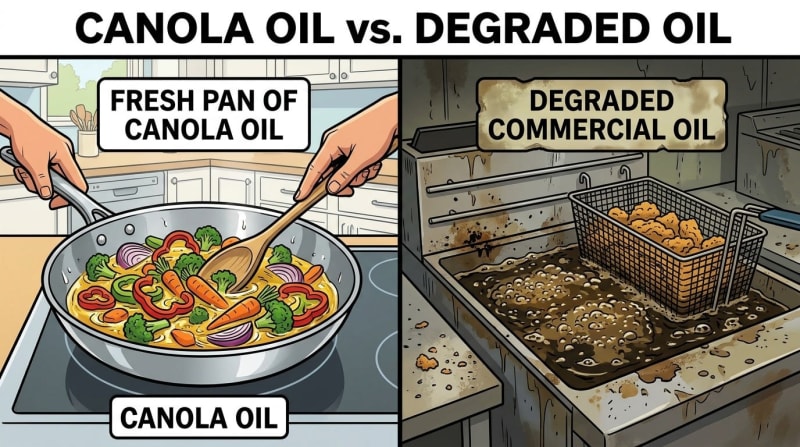
Polyunsaturated fats are chemically unstable at high temperatures. When you repeatedly heat a PUFA-heavy oil — especially past its smoke point — it breaks down into compounds called aldehydes and lipid peroxides. These are genuinely harmful. Animal studies linking high-temperature oxidized oils to tissue damage are not controversial. The question is whether home cooking creates the same exposures.
The answer is almost certainly no — not even close. Restaurant deep-frying uses oil that cycles through hundreds of sessions over multiple days, reaching temperatures that cause significant degradation. Home stir-fry with fresh canola oil is a fundamentally different chemical exposure. The research on oxidation products typically measures oil after repeated heating cycles at sustained high temperatures, not a single sauté.
Smoke point isn't everything — the stability of the oil's fatty acid profile matters alongside it. But for most home cooking scenarios, refined canola or sunflower oil heated once to sautéing temperature is a very different thing than the oil in a commercial fryer running continuously for days.
The processing distinction is also worth making. Cold-pressed or expeller-pressed oils are extracted at lower temperatures and retain more of their natural antioxidants, reducing oxidation before the oil even reaches your kitchen. Refined oils go through higher-temperature extraction and deodorizing processes. A bottle of cold-pressed sunflower oil has a different starting profile than its refined counterpart — and neither is equivalent to repeatedly heated commercial frying oil.
If you're roasting vegetables at 400°F with fresh oil and a bottle that's been closed between uses, you're in a different conversation than the one happening on social media.
What the Longest-Running Studies Found

What the Longest-Running Studies Found
The randomized controlled trial evidence is the most important part of this debate — and the most frequently misrepresented.
The Minnesota Coronary Experiment (1968–1973) is often cited as evidence against seed oils. In that study, replacing saturated fat with linoleic acid from corn oil lowered LDL cholesterol — but did not reduce cardiovascular mortality, and a 2016 reanalysis published in the BMJ found higher mortality rates in the group eating more linoleic acid. This is a real finding. The context: participants were already hospitalized or institutionalized, average age 52, mostly with existing heart disease. The intervention replaced saturated fat with linoleic acid without any increase in omega-3 intake. Whether that applies to a generally healthy person cooking at home is genuinely debated among researchers.
The Sydney Diet Heart Study reanalysis, published in the BMJ in 2013, found similar results: replacing saturated fat with safflower oil — very high in linoleic acid, very low in omega-3 — increased all-cause mortality in men recovering from coronary events. Again, a single-oil intervention in a high-risk population, without omega-3 adequacy.
What both studies share is the absence of omega-3. That's the signal worth paying attention to.
The Mediterranean pattern trials tell a different story. PREDIMED (Prevención con Dieta Mediterránea), a large Spanish randomized trial, showed that a Mediterranean diet supplemented with extra virgin olive oil or nuts reduced major cardiovascular events by roughly 30% compared to a low-fat control diet. The Lyon Diet Heart Study — which emphasized alpha-linolenic acid (a plant omega-3) alongside a Mediterranean pattern — showed a 73% reduction in cardiac events over four years.
The pattern across these trials is consistent: seed oils alone, replacing saturated fat without omega-3 adequacy, produce mixed results. Seed oils as part of a dietary pattern that includes adequate omega-3, vegetables, and overall dietary quality produce clear benefit.
The question was never "are seed oils good or bad?" It was always "compared to what, and in what context?"
What to Actually Do: A Decision Framework
What to Actually Do: A Decision Framework
The evidence doesn't support throwing out your pantry. It also doesn't support ignoring what you're cooking with.
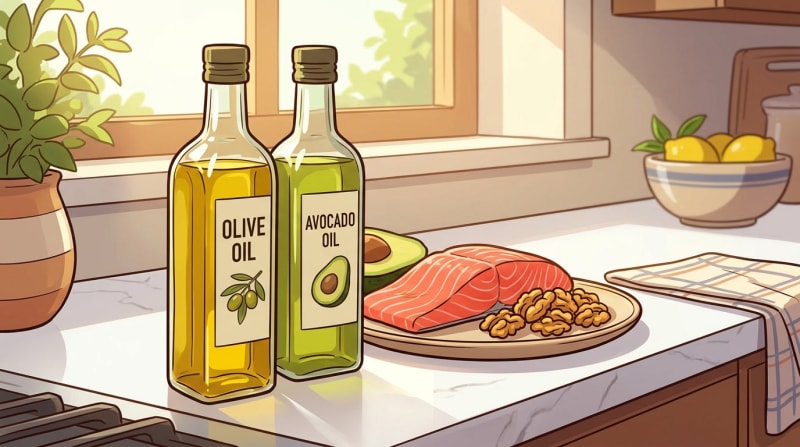
For most heat applications — sautéing, roasting, finishing — extra virgin olive oil is the most evidence-backed choice. It holds up reasonably well to moderate heat, it's high in oleic acid (a monounsaturated fat that's stable and linked to anti-inflammatory effects), and it's the primary fat in the dietary patterns with the clearest positive trial data. The AHA notes that replacing saturated fat with omega-6 PUFAs reduces LDL cholesterol by approximately 10-15% — a real, measurable benefit that gets lost in the all-or-nothing framing. Olive oil does that while also fitting the Mediterranean pattern with the strongest outcomes data.
Avocado oil has a higher smoke point and a fatty acid profile similar to olive oil. It's a reasonable choice for higher-heat cooking where you want a neutral flavor. Both are worth keeping.
Seed oils in packaged food deserve a different calculation than seed oils in your own kitchen. Occasional exposure to seed oils in real food isn't the issue. The problem with ultra-processed food is the pattern — refined carbohydrates, engineered palatability, sodium — not the oil in isolation. Dose matters, and context matters more.
The highest-impact move the evidence consistently supports is increasing omega-3 intake, not eliminating omega-6. Fatty fish two to three times per week provides meaningful EPA and DHA — the omega-3 forms your body uses most directly. Walnuts, flax, and chia seeds provide ALA, the plant-form omega-3 (conversion to EPA and DHA is modest but not zero). If fish isn't a regular part of how you eat, algae-based omega-3 supplements provide EPA and DHA directly, without the fish.
The seed oil debate has framed the choice as: eat seed oils and suffer chronic inflammation, or eliminate them and restore ancestral health. The evidence doesn't support either pole. What it supports is a dietary pattern — abundant vegetables, adequate omega-3 from fish or supplementation, olive oil and avocado oil as primary cooking fats, and a dose of realism about what occasional exposure to packaged food actually costs you.
What would it look like if, instead of eliminating anything, you spent the next month adding two servings of fatty fish per week? That's the intervention the evidence points to most clearly — and it doesn't require throwing anything away.
Content ID: glk8nxfSt1n2PJmbpVC8Xqz4
See an error? Tell us.
Keep Reading

What North Carolina's New Food Is Medicine Coalition Reveals About Building State Coalitions from Scratch

What the New FIMC Multi-State Evidence Report Reveals About FIM Cost Savings — and Why High-Acuity Patients Are the Key

Child Care Is the Largest Untapped FIM Delivery Platform — A New Report Shows What's Missing
Comments
Share with the Community