

When 358 Clinicians Write to the Governor About SNAP: The Avoidable-Cost Framework FIM State Officers Need Now
The Short Version
- 358 Massachusetts clinicians put a $237 billion annual figure on the avoidable healthcare costs of food insecurity — framing SNAP as a prescription that prevents far more expensive care downstream.
- Massachusetts child SNAP enrollment fell 18% since July 2025, driven by administrative barriers rather than reduced need — the third-steepest state decline nationally.
- Losing SNAP automatically eliminates WIC and free school meal eligibility, removing multiple FIM client-identification touchpoints in a single enrollment failure.
- 75% of DTA calls in Massachusetts were automatically disconnected in 2026, a staffing-ratio preview of what H.R. 1 work reporting requirements will do in every state.
- The pooled-risk argument — unaddressed food insecurity raises premiums for all insured patients — gives FIM state officers a cost-center frame Medicaid managed care plans are built to respond to.
On September 1, 2026, 358 Massachusetts healthcare providers — nurses, physicians, social workers, registered dietitians — signed a letter to Governor Maura Healey making an argument that most of them make at bedsides every day: SNAP food insecurity is generating avoidable healthcare costs, and reducing enrollment barriers is the most direct way to reduce them. The letter, organized by Children's HealthWatch and the Massachusetts Association of Community Health Workers, opens with a line that reads like a prescription pad: Like a Prescription, SNAP Protects Health. For Food is Medicine (FIM) state officers building the case with Medicaid managed care plans, this letter is a new evidence tool.
A Healthcare System Making the FIM Argument to State Government

A Healthcare System Making the FIM Argument to State Government
The letter's argument is clinical observation, not advocacy language. Unaddressed SNAP enrollment barriers are generating avoidable clinical encounters: hospitalized children, worsened hypertension, diabetes complications, developmental delays. The 358 signatories are not policy organizations — they are the people writing the discharge summaries.
What makes the letter useful beyond Massachusetts is its structure. It frames the problem as an avoidable-cost problem, not a poverty problem. That distinction matters when the audience is a Medicaid managed care plan. Payers respond to cost frameworks. The letter provides one.
The $237 Billion Number FIM Operators Can Use in Medicaid Conversations

The $237 Billion Number FIM Operators Can Use in Medicaid Conversations
The actuarial center of the letter is a single figure: researchers estimate that food insecurity generates $237 billion in avoidable healthcare costs annually across the United States. Massachusetts alone accounted for $2.4 billion of that total in 2018 — a number the letter notes has "likely ballooned due to increased costs and inflation."
Those costs do not stay inside the food-insecure population. The letter makes the pooled-risk argument directly:
"Healthcare is inherently a system of pooled risk, with the cost of care needed to care for sicker patients passed onto all patients via increased health insurance premiums and increased cost at point of service."
— Children's HealthWatch et al., letter to Governor Healey, September 1, 2026
This is the food is medicine ROI framing FIM state officers need when presenting to Medicaid payers. Unaddressed food insecurity is not an enrollee problem — it is a plan-wide premium problem. An estimated 14 million Medicaid enrollees, including 7 million children, are food-insecure. When a managed care plan pushes back on FIM program costs, the $237 billion figure is the counterargument: the cost of inaction is already priced into premiums.
The SNAP-to-FIM Cascade: What the Massachusetts Data Reveals
The SNAP-to-FIM Cascade: What the Massachusetts Data Reveals
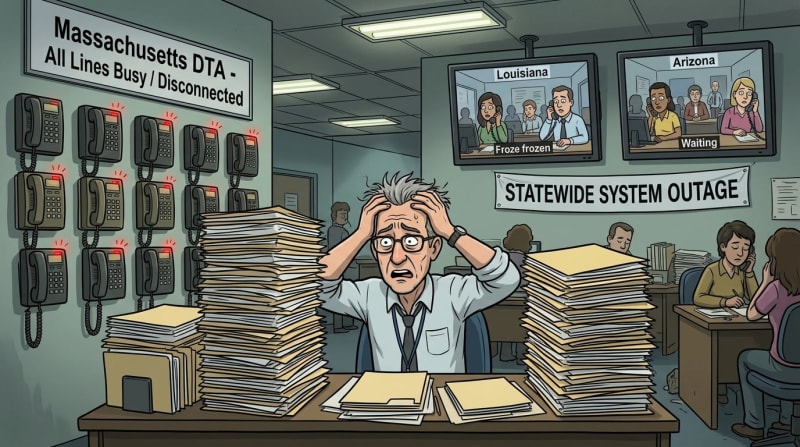
The Massachusetts data shows what declining SNAP enrollment does to the FIM client pipeline. Since July 2025, child SNAP enrollment in Massachusetts has fallen 18% — the third-highest decline nationally, behind Louisiana at 23% and Arizona at 49%. The drop is not driven by reduced need. Administrative barriers are.
The cascade runs downstream from every lost enrollment. Losing SNAP eligibility automatically eliminates eligibility for WIC and free school meals — two programs FIM providers use to identify and refer food-insecure clients. One enrollment failure removes multiple nutrition touchpoints simultaneously.
The system capacity signal is already visible. In 2026, at least 75% of calls to reach a Massachusetts DTA worker were automatically disconnected — a staffing-ratio problem, not a seasonal dip. H.R. 1's expanded work reporting requirements will impose the same administrative burden on every state DTA. FIM state officers in Arizona and Louisiana are already operating inside the more severe version of this environment.
The Massachusetts letter gives them a peer-reviewed cost framework to bring into state Medicaid negotiations before the enrollment declines in their states finish working through the FIM referral pipeline. The Children's HealthWatch letter is available in full and citable in payer conversations in any state.
Content ID: n1K0xjxNG46HUuTTGeoP5Gej
See an error? Tell us.
Keep Reading

What North Carolina's New Food Is Medicine Coalition Reveals About Building State Coalitions from Scratch
What the New FIMC Multi-State Evidence Report Reveals About FIM Cost Savings — and Why High-Acuity Patients Are the Key

Child Care Is the Largest Untapped FIM Delivery Platform — A New Report Shows What's Missing
Comments
Share with the Community