

Resistant Starch: The Carb That Feeds Your Gut Bacteria Instead of Your Blood Sugar
The Short Version
- Resistant starch passes through the small intestine intact and reaches the colon, where gut bacteria ferment it into butyrate and other short-chain fatty acids — these contribute roughly 10% of daily human energy needs drawn from the colon, not the bloodstream.
- Cooling cooked rice, pasta, or potatoes overnight increases their resistant starch content by 2–4 times, and reheating does not fully erase that gain — leftover rice is genuinely different from freshly cooked rice.
- A 2020 meta-analysis found resistant starch supplementation reduced fasting glucose by approximately 0.39 mmol/L, and the second-meal effect — RS at breakfast blunting blood sugar spikes at lunch — has been replicated across multiple human trials.
- The average American eats about 5 grams of resistant starch per day; studies showing meaningful gut and blood sugar benefits typically use 15–30 grams — a gap closeable with food, not supplements.
- Microbiome changes from consistent RS intake are measurable within two weeks and continue improving through four weeks; starting low and increasing gradually avoids the bloating that comes with adaptation.
There is a version of last night's rice sitting in your refrigerator right now that is doing something different in your body than the bowl you ate warm. Not because the flavor changed — it probably didn't much. But because the starch inside it has. When cooked starch cools, it recrystallizes into a structure that human digestive enzymes cannot fully break down. It passes through the small intestine largely intact, arrives in the colon, and gets eaten — not by you, but by the bacteria living there. If you have ever eaten cold potato salad, a firm green banana, or oats soaked overnight in the refrigerator, you have already been collecting resistant starch benefits without knowing it.
Most carbohydrate conversations center on what foods do to blood sugar. Resistant starch shifts that framing entirely: this is a carbohydrate that largely bypasses blood sugar and becomes food for your gut microbiome instead.
What Makes Resistant Starch Different From Regular Starch
What Makes Resistant Starch Different From Regular Starch
Regular dietary starch — in freshly cooked white rice, a hot baked potato, white bread, or most processed grain foods — is broken down by amylase enzymes in the small intestine, converted to glucose, and absorbed into the bloodstream. Resistant starch is starch that escapes this process. It is physically or chemically structured in a way that digestive enzymes cannot fully access, so it travels through the small intestine intact and arrives in the large intestine where gut bacteria ferment it.
There are four recognized types, but two matter most for practical cooking:
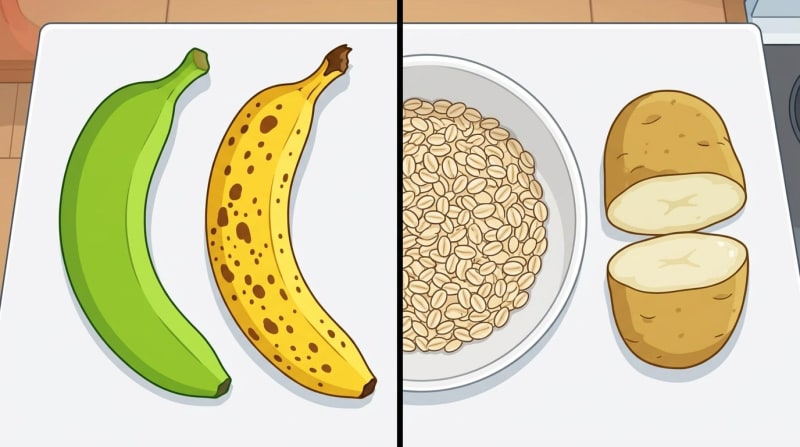
RS2 forms naturally in raw or unripe foods. The dense, tightly packed granule structure in green bananas, raw oats, and raw potatoes physically shields the starch from enzymes. Cooking disrupts that structure — which is why a spotted-ripe banana and a firm green one behave very differently in the body.
RS3 — retrograde starch — forms when cooked starch is cooled. During cooking, starch granules absorb water and swell. During cooling, they partly recrystallize into a structure that is more resistant to digestion than the original, through a process called retrogradation. A 2013 review published in Nutrients documented that this process increases resistant starch content by 2–4 times compared to freshly cooked versions.
Processed and ultra-processed foods tend to have substantially less of both. Fine milling, pre-gelatinization, and high-heat manufacturing remove or destroy the structural properties that make RS2 and RS3 useful. Whole food preparation — with its natural structure intact and the option to cook-and-cool — preserves them.
Here is how resistant starch content compares across some foods that most home cooks already keep on hand:
The gap between a green banana and a bowl of freshly cooked rice is striking — and it tells you that source and preparation together determine how much resistant starch you are actually eating.
What Resistant Starch Does in Your Gut

What Resistant Starch Does in Your Gut
When resistant starch reaches the colon, the bacteria there ferment it. The outputs of that fermentation are short-chain fatty acids (SCFAs) — primarily butyrate, propionate, and acetate. A comprehensive review in Nutrients found that resistant starch fermentation contributes approximately 10% of total daily human energy needs, drawn from the colon rather than the small intestine. That challenges the common assumption that indigestible carbs are nutritionally inert.
Butyrate is the most studied of the three. Colon cells use it as their primary energy source, and it plays a significant role in maintaining the intestinal barrier, reducing local inflammation, and modulating immune responses in the gut lining. Low butyrate availability is associated with inflammatory bowel conditions; consistent fermentation of resistant starch is one of the mechanisms by which fiber-rich diets are thought to be protective.
Here is how resistant starch fermentation divides into its three fatty acid outputs:
Resistant starch also shows meaningful selectivity in which bacteria it feeds. A 2021 study in BMJ Gut tracked microbiome changes in healthy adults over four weeks of a high-RS diet. Bifidobacterium and Lactobacillus populations increased significantly, while pathogenic Bacteroides — associated with gut inflammation — decreased. These are not generic categories. They are well-characterized species with known roles in immune regulation and intestinal health. This selectivity is part of what makes resistant starch distinct from general dietary fiber, which tends to feed a broader, less targeted range of bacterial populations.
What are you already eating that might be selectively feeding the bacteria that matter most — and what would it mean to do more of that on purpose?
The Blood Sugar Effect: What the Research Actually Shows

The Blood Sugar Effect: What the Research Actually Shows
Resistant starch affects blood sugar through two distinct pathways. The first is direct: starch that passes through the small intestine without being digested does not contribute to a glucose spike. Less digestible carbohydrate absorbed per meal means a smaller postprandial glucose rise.
The second pathway takes a longer view. A 2020 meta-analysis synthesizing multiple randomized controlled trials found that resistant starch supplementation reduced fasting glucose by approximately 0.39 mmol/L and improved insulin resistance markers across the studies reviewed. The same analysis confirmed the second-meal effect — where resistant starch consumed at breakfast produces a measurably blunted glucose response at lunch, even when lunch contains no resistant starch at all. The mechanism is thought to involve SCFAs produced during overnight fermentation signaling hormonal responses that slow gastric emptying and improve insulin sensitivity for hours after the initial meal.
The honest framing: resistant starch is not a treatment for blood sugar problems, and individual response varies meaningfully based on existing microbiome composition. But for people who already eat starchy foods — which is most people — choosing preparations that preserve or increase RS content is a real dietary shift with a documented and consistent effect direction. The infrastructure is already there. The food is already on the table. The question is mostly one of preparation.
The Cooling Trick: How to Add Resistant Starch to Foods You Already Eat
The Cooling Trick: How to Add Resistant Starch to Foods You Already Eat
The practical picture here is genuinely good. You do not need new foods, specialty products, or any major shift in how you cook. You mostly need a refrigerator and a little planning.
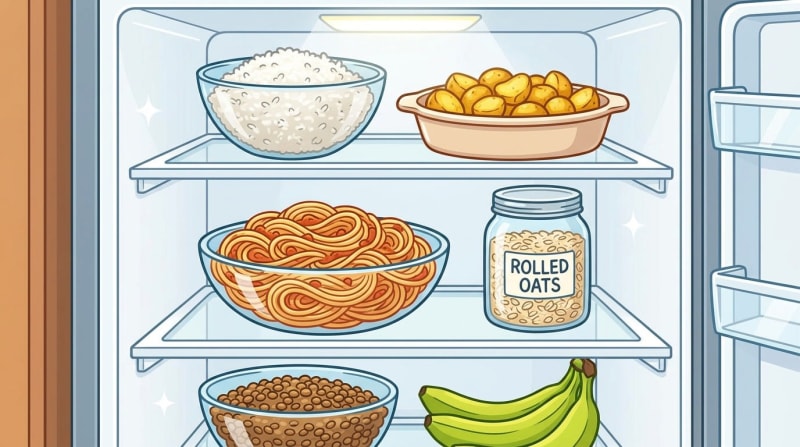
Cook starches and refrigerate them. Rice, pasta, potatoes — prepare them as you normally would, then cool and refrigerate. The retrogradation process begins as the food cools and continues over several hours. Overnight refrigeration produces the best results. The RS content increase documented in the research is 2–4 times what freshly cooked versions contain.
Reheating does not eliminate the benefit. This is one of the most practically useful pieces of information about RS3. When cooled rice or pasta is reheated, some of the recrystallized starch converts back — but not all of it. Mild reheating only partially disrupts the retrograde structure. Warmed-up leftover rice still contains significantly more resistant starch than freshly cooked rice served immediately. Cold pasta salad or cold potato salad, eaten without reheating, retains the full cooling benefit.
Foods that are naturally high in RS2: Green or just-turning bananas — the spotted-ripe ones have lost most of it. Raw rolled oats prepared as overnight oats, soaked cold rather than cooked, retain RS2 that heat would destroy. Legumes — lentils, chickpeas, black beans, white beans — are reliably high in resistant starch regardless of temperature, because their cell wall structure physically protects the starch from digestion even after cooking.
Most of these are foods that home cooks already use. The shift is less about adding something new than recognizing what is already working.
How Much Do You Need and What Should You Expect

How Much Do You Need and What Should You Expect
Research studies that show meaningful effects on gut bacteria and blood sugar typically use doses of 15–30 grams of resistant starch per day. The current average intake in the United States is estimated at approximately 5 grams per day. That gap is significant — and also closeable through food alone without supplementation.
Getting from 5 to 15 grams daily is achievable without reinventing your diet. A green banana (roughly 10–15g RS), a serving of overnight oats (about 6–8g RS), and a lunch built around yesterday's refrigerated rice or a bowl of cold lentils will get you to the lower end of the research range without any specialty purchases.
One genuine heads-up: go slowly at first. As gut bacteria shift toward fermenting more resistant starch, gas and bloating are common in the first one to two weeks. This is adaptation, not a reaction to something harmful. Starting with one RS-rich meal per day and increasing gradually over two to three weeks gives bacterial populations time to adjust.
The BMJ Gut study found microbiome changes observable within two weeks of consistent RS intake, with continued improvement through four weeks. That timeline is worth holding when the first week of overnight oats feels like it isn't producing anything visible. What is happening in the colon is real — it is just the kind of change that works before you feel it.
What would it look like to build one resistant-starch habit into a meal you already make every week — not as a project, but as a quiet shift in how you prepare something familiar?
Content ID: 74W3qzO8OA4l1kqZhB1vaEPm
See an error? Tell us.
Keep Reading

What North Carolina's New Food Is Medicine Coalition Reveals About Building State Coalitions from Scratch

What the New FIMC Multi-State Evidence Report Reveals About FIM Cost Savings — and Why High-Acuity Patients Are the Key

Child Care Is the Largest Untapped FIM Delivery Platform — A New Report Shows What's Missing
Comments
Share with the Community