

French Fries and Diabetes Risk: The 40-Year Study That Changes How You Think About Potatoes
The Short Version
- A 40-year study of 205,000+ people found that eating french fries 3 or more times per week raised Type 2 diabetes risk by 20% — baked and boiled potatoes showed no meaningful risk increase at all.
- Frying transforms potatoes with acrylamide, oxidized fats, and advanced glycation end products that affect insulin signaling — the potato itself isn't the culprit, the high-heat oil bath is.
- Cooked-and-cooled potatoes develop resistant starch that acts like dietary fiber: potato salad has a glycemic index of roughly 35 compared to 85 for a hot baked potato.
- Three servings per week is a pattern, not an event — the study's finding is about routine fried-potato consumption, not the occasional basket at a diner or a cookout.
- High-heat oven roasting and air frying deliver crispy texture at less than a quarter of deep frying's fat content — a real upgrade for everyday cooking that doesn't require giving up the actual fries.
There is a particular kind of nutrition headline that reads like a verdict — and at first glance, this one looked like another one. A 40-year study. Two hundred and five thousand people. A finding that ties french fries to elevated Type 2 diabetes risk. The instinct is to brace. But read past the headline, and what this research actually says is something worth understanding carefully: the french fries diabetes risk finding is real, the science behind it is genuinely interesting, and the practical takeaway is more useful — and less punishing — than most nutrition stories manage to be.
What the French Fries Diabetes Risk Study Actually Found

What the French Fries Diabetes Risk Study Actually Found
The study tracked the dietary patterns of more than 205,000 participants over four decades, making it one of the most substantial long-term nutrition investigations on record. Duration matters in this kind of research because short-term food studies are notoriously unreliable — what a person eats for two weeks tells you very little about disease outcomes measured over a lifetime. This study had time, and scale, working in its favor.
According to a June 2026 summary published in ScienceDaily, participants who ate three or more weekly servings of fried potatoes had a 20% higher risk of developing Type 2 diabetes compared to those who ate baked or boiled potatoes with similar frequency. That's a meaningful association — not negligible, not catastrophic, but consistent across a population of hundreds of thousands of people over decades.
The more important finding is what the data didn't show: baked and boiled potatoes had no meaningful increase in diabetes risk. When researchers controlled for preparation method, the potato itself was essentially cleared. The variable isn't the food — it's the way we cook it.
What does three servings per week look like in practice? It's not fries at a summer cookout or a shared basket at a diner with friends. It's closer to fried potatoes as a consistent routine — a near-default several times a week rather than an occasional choice. The study is describing a pattern, not an event.
What Frying Does to a Potato (That Baking Doesn't)
What Frying Does to a Potato (That Baking Doesn't)
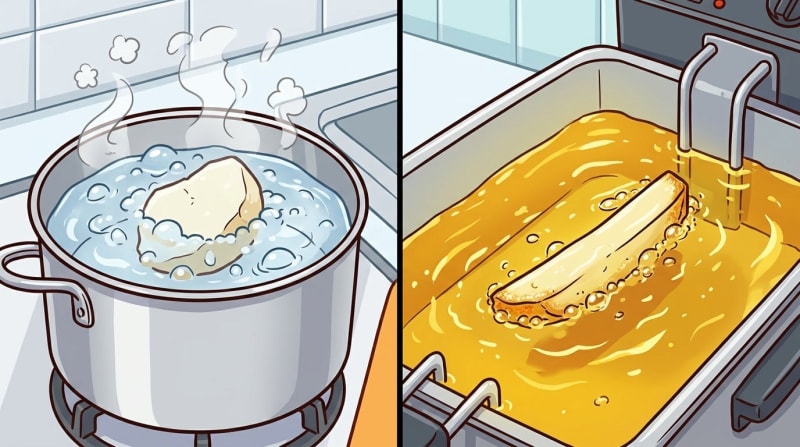
When you boil or bake a potato, the starch granules absorb water and swell in a way that leaves most of the food's structural integrity and nutritional profile intact. When you fry one, you're driving moisture out rapidly while submerging the starch in oil at temperatures above 350°F. The chemistry that follows is genuinely different.
At high heat, starches and naturally occurring amino acids in the potato react to form acrylamide — a compound the FDA has flagged as a process contaminant associated with disruptions in insulin signaling pathways. Advanced glycation end products, or AGEs, also form during high-heat cooking; these compounds have been linked in research to increased insulin resistance and oxidative stress. Neither forms in meaningful quantities when a potato is boiled.
Then there's the oil absorption. A fried potato takes on a significant amount of fat from the cooking medium — and in commercial frying, oils are heated repeatedly to high temperatures, producing oxidized fatty acids that behave differently in the body than fresh fat. The caloric difference between a boiled and a fried potato isn't subtle, as USDA FoodData Central data makes clear per 100 grams:
The blood sugar picture follows a similar pattern. Frying disrupts the potato's starch structure in ways that accelerate glucose release. The combination of fast-releasing starch and AGEs creates a different metabolic transaction than the same potato baked or boiled — and the potato glycemic index alone doesn't fully capture it.
The Resistant Starch Angle (Why Cooled Potatoes Are Different)
The Resistant Starch Angle (Why Cooled Potatoes Are Different)
Here is where potato science gets genuinely interesting — and where you get something real back.
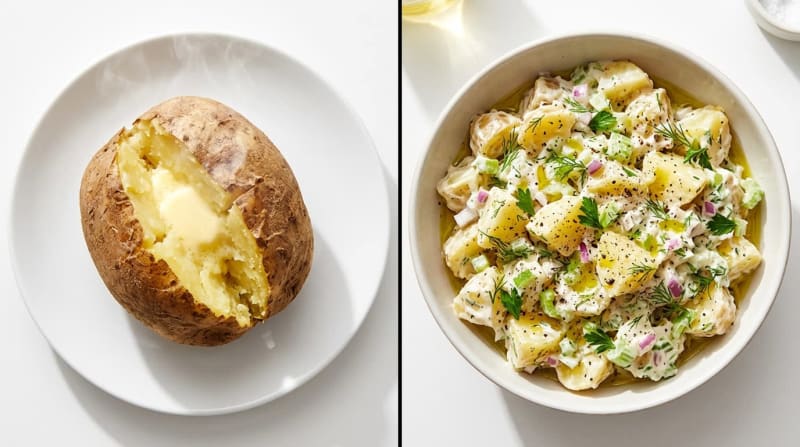
When potatoes are cooked and then allowed to cool, the starch undergoes a process called retrogradation: the molecules rearrange into a tightly bonded crystalline structure known as resistant starch. Unlike regular digestible starch, resistant starch passes through the small intestine largely intact, feeding gut bacteria rather than triggering an immediate insulin response. It behaves more like dietary fiber than like a carbohydrate.
The practical implication is significant: potato salad made from boiled, cooled potatoes has a measurably lower glycemic impact than the same potato served hot — including lower than a baked potato, which many people default to as the healthier preparation. Glycemic index research data shows the spread clearly:
Cold potato preparations — potato salad with olive oil and herbs, sliced cold potatoes over greens, leftover boiled potatoes added to a lunch bowl — aren't a compromise. They're a distinct food in terms of how your body processes them. Cooking a batch of potatoes on Sunday and serving them cold Monday isn't just convenient. It's doing something structurally different in your gut.
What else in your kitchen might behave differently depending not just on what it is, but on how you've treated it before it hits the plate?
What This Means for Fries, Diabetes Risk, and Your Daily Cooking

What This Means for Fries, Diabetes Risk, and Your Daily Cooking
The 20% risk figure is not an argument against fries. The study identified a risk pattern associated with eating fried potatoes three or more times per week, consistently, over time. That's the finding. A basket of fries on a Friday night, a side at a roadside diner, fries at the beach because fries at the beach are one of life's specific pleasures — that's not what this research is describing.
The honest question is whether fries are functioning as a routine or as an occasion in your actual cooking week. Those are genuinely different patterns, and the research speaks to the pattern.
When the goal is crispy potatoes at home — a real preference worth honoring, not suppressing — the fat difference between cooking methods matters. Here's how the numbers compare:
A hot oven — 425 to 450°F — with a light coating of olive or avocado oil produces potatoes with a genuinely crispy exterior at less than a quarter of the fat load of deep frying, and without the oil degradation that comes from commercial frying. An air fryer gets there with slightly more fat and even less time. The texture isn't identical to a deep-fried potato — full oil submersion creates something specific that roasting approximates but doesn't perfectly replicate — but high-heat roasted potatoes are their own excellent thing, not a pale substitute.
A practical framework: when you actually want fries — real fries, hot and salted and exactly what the moment calls for — get the fries. When you're making potatoes at home as a weeknight side and crispy is the goal, roast them. The upgrade is in the default, not in eliminating the exception.
The Potato Is Not the Problem

The Potato Is Not the Problem
A medium potato with the skin on contains roughly 897mg of potassium — around 19% of the daily value — along with significant vitamin C, vitamin B6, and nearly 4 grams of dietary fiber. It has no fat of its own, no sodium, and more potassium per calorie than almost any other whole food you'd put on a plate.
Here's the nutrient profile of a medium skin-on baked potato as a percentage of daily value, per USDA data:
The 40-year study does not indict the potato. It describes what happens when the potato is systematically transformed by high-heat frying — a process that introduces significant oil, creates compounds that affect insulin signaling, and removes the resistant starch and fiber advantages the potato naturally carries. Removing potatoes from your kitchen in response to this research would be precisely the wrong interpretation of the data.
"The potato is not the problem. What we do to it in the fryer is worth understanding — and that's actually good news."
This kind of research, read carefully, gives you more freedom with food, not less. Boil them, roast them, cool them and make salad. Eat the actual fries when fries are what the moment genuinely calls for. The study found that people eating baked and boiled potatoes regularly showed no meaningful increase in diabetes risk — that's data in the potato's favor, and it belongs in the same headline as the fries finding.
What would it look like to use this research as permission — permission to cook potatoes more ways, more often, with less ambient guilt about a food that has been nourishing people for ten thousand years?
The potato is still on your side.
Content ID: YPhK82bzKzxXckfzSWcbj3RP
See an error? Tell us.
Keep Reading

What North Carolina's New Food Is Medicine Coalition Reveals About Building State Coalitions from Scratch

What the New FIMC Multi-State Evidence Report Reveals About FIM Cost Savings — and Why High-Acuity Patients Are the Key

Child Care Is the Largest Untapped FIM Delivery Platform — A New Report Shows What's Missing
Comments
Share with the Community