
The $45 Billion Local Economy Case for Food Is Medicine: A New Argument for State Budget Negotiations
The Short Version
- A March 2026 Rockefeller Foundation report puts the food is medicine economic impact at $45 billion in local economic activity — a number that reaches budget committees differently than health savings evidence alone.
- Diet-related conditions cost Americans more than $1.1 trillion annually, and medically tailored meals could recover $13.6 billion of that spend each year if deployed to all eligible people.
- Procurement policy is the policy ask: states that write in-state sourcing preferences into FIM contracts keep healthcare dollars circulating locally through farms, food preparation jobs, and community organizations.
- The July 2026 CHCS brief provides ready-to-use budget testimony language: FIM 'has been shown to decrease emergency department use, lower costs, and support long-term healthy eating for improved health outcomes.'
- Both the economic evidence and the implementation roadmap are in place for FIM advocates — what remains is whether every state officer is using all of it in the room where budget decisions happen.
State budget hearings have a particular rhythm. Health outcomes data is presented. The room nods. Then the fiscal question comes: what does this cost, and what does the state get back? For Food Is Medicine advocates, that question has long been the harder one to answer — not because the evidence is weak, but because health evidence speaks a different language than budget committees use. Two major reports published in 2026 change that. The Rockefeller Foundation's March 2026 From Farm to FIM report documents $45 billion in potential nationwide economic activity from locally procured FIM programs. The Center for Health Care Strategies' July 2026 policy brief maps the implementation levers available in state Medicaid systems. Together, they make the food is medicine economic impact case in terms budget committees understand — and respond to.
Why Health Evidence Alone Is Not Winning Every Budget Fight

Why Health Evidence Alone Is Not Winning Every Budget Fight
This is not an indictment of health outcomes evidence. It is a recognition of how budget hearings actually work.
FIM state officers working through programs like the Rockefeller Foundation's FIM State Officer Program have solid clinical evidence in hand: medically tailored meals reduce hospitalizations, improve management of diet-related chronic conditions, and support better long-term health in the populations most likely to utilize Medicaid services. The evidence is there.
The challenge is that budget committees sometimes receive health outcome evidence as a healthcare cost argument — which positions FIM against every other healthcare program competing for the same appropriation. It becomes a tradeoff conversation rather than an investment conversation.
Economic activity arguments work differently. When a state procurement decision keeps dollars in-state — through local farms, regional food producers, and community-based organizations preparing medically appropriate meals — those dollars don't just exit the healthcare system. They circulate. They pay wages, support farms, and generate economic activity within the state's own boundaries. That is an argument that lands differently in a budget hearing.
What the dual-track pitch offers — health ROI plus economic multiplier — is a way to answer both questions budget committees ask: "Does this work?" and "What does the state gain beyond reduced healthcare spending?" What becomes possible when the FIM conversation expands to include economic development staff, agriculture departments, and rural economic advocates — not just health administrators and Medicaid directors?
The March 2026 Rockefeller Report: $45 Billion in Nationwide Economic Activity

The March 2026 Rockefeller Report: $45 Billion in Nationwide Economic Activity
The Rockefeller Foundation's From Farm to FIM: The Economic Impact of Local Food is Medicine, published March 11, 2026, is the primary source for the economic argument. Its central finding: when states prioritize locally based providers and food sourced from in-state and regional producers, Food is Medicine programs can generate $45 billion in economic activity nationwide.
"When states intentionally prioritize locally based providers and food sourced from in-state and regional producers — it can support small and mid-sized farms, create jobs, and keep dollars circulating within communities."
— Rockefeller Foundation, From Farm to FIM: The Economic Impact of Local Food is Medicine, March 11, 2026
The mechanism is worth naming precisely, because this is where the budget argument becomes actionable. This is not a theoretical multiplier — it is a procurement decision. States that write FIM program contracts with explicit in-state and regional sourcing preferences create a pathway for healthcare dollars to benefit local agricultural economies. Small and mid-sized farms that might not otherwise access institutional food purchasing become eligible participants. Jobs in food preparation, distribution, and coordination within the state are sustained rather than sent to national supply chains.
For state FIM officers, the $45 billion figure is not simply a headline — it is a policy ask embedded in a report. The ask is: design procurement language to prioritize local. The return is economic activity that stays in state, visible to the same legislators who approved the appropriation.
Layering the Healthcare Savings Argument: $13.6 Billion and $1.1 Trillion
Layering the Healthcare Savings Argument: $13.6 Billion and $1.1 Trillion
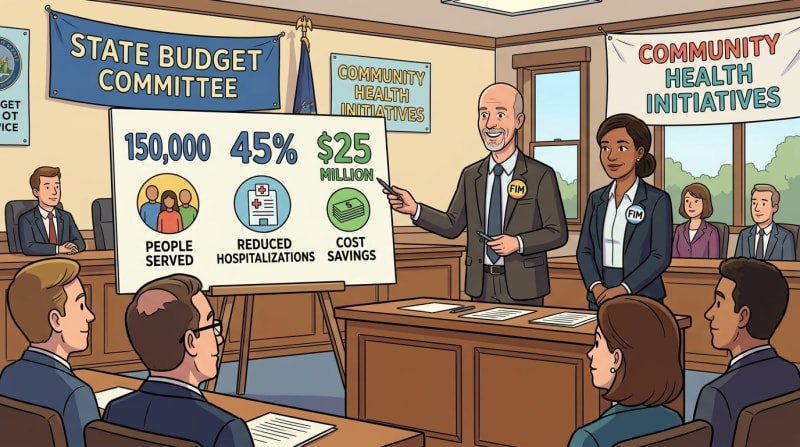
The economic activity argument works best when layered on top of — not substituted for — the healthcare savings evidence. The Rockefeller Foundation estimates that if all eligible Americans received medically tailored meals, $13.6 billion in healthcare spending could be saved annually. That is the clinical return on FIM investment.
The cost burden that FIM addresses is substantial: diet-related conditions drive more than $1.1 trillion in annual healthcare costs in the United States each year — a figure the Rockefeller Foundation independently confirms, making it citable from two authoritative sources in the same budget testimony.
In a state budget hearing, the sequence matters. Present the cost burden first. Then present the medically tailored meals savings evidence. Then present the local economic activity argument. Three distinct numbers, three distinct reasons to fund FIM, none of them the same argument, none competing with the others for the same line item.
What would a state budget hearing look like if FIM advocates walked in with all three of these arguments ready, sequenced, and supported by the same two 2026 sources?
What the July 2026 CHCS Brief Says About Implementation Levers

What the July 2026 CHCS Brief Says About Implementation Levers
The Rockefeller report makes the economic case. The Center for Health Care Strategies State Policy Pathways brief, published in July 2026, provides the implementation architecture: policy levers, state authorities, and best practices across Medicaid and other state systems.
The brief gives FIM state officers language that can be used in budget testimony directly: when strategically combined with existing nutrition assistance programs, Food is Medicine has been shown to decrease emergency department use, lower costs, and support long-term healthy eating for improved health outcomes. Each element maps to a specific budget concern. Emergency department use reduction matters to Medicaid actuaries. Lower costs matter to appropriations committees. Long-term healthy eating introduces a prevention argument that extends the return on investment beyond a single program year.
The Rockefeller Foundation's FIM State Officer Program connects this state-level work across jurisdictions — officers are not building the economic case independently in each state but as part of a coordinated national effort, with shared resources and shared language. What these two 2026 reports give to FIM advocates is something practical: a vocabulary that translates the program's value into terms fiscal decision-makers recognize. That is the gift — the language to be heard differently, in the room where funding decisions are made.
The evidence exists. The implementation roadmap exists. What changes when every state officer walks into a budget hearing carrying both?
Practical Guidance: Using the Economic Case in Your State

Practical Guidance: Using the Economic Case in Your State
The primary resource for the economic case is the Rockefeller Foundation's From Farm to FIM report. It is designed for exactly the use case state officers face: presenting an economic multiplier argument alongside health outcomes evidence in legislative hearings. The $45 billion figure is the lede. The local procurement policy ask follows naturally from it.
The CHCS State Policy Pathways brief provides the implementation architecture. Used together, these two 2026 documents give a state officer both the economic argument and the policy roadmap. Both were published this year and reflect the current state of the field.
For identifying locally-based FIM providers eligible for in-state and regional procurement preferences, the starting point is existing Medicaid managed care contracts and state agriculture department lists of certified local producers. The produce prescription programs and medically tailored meal providers already operating in-state are often eligible for regional procurement prioritization under existing procurement authority — they need the contract language to activate that preference, not a new category of provider.
The Rockefeller Foundation's FIM Impact Fund connects individual state efforts to a national network of advocates building this same case. State officers are not constructing the economic argument from scratch, and they are not doing it alone.
The question is not whether the food is medicine economic impact case is real. The research confirms that it is, from two independent sources using the same cost burden figure. The question is whether the advocates making this argument in each state have the right vocabulary in front of the right people — and whether the full case, economic and clinical, is landing in the rooms where it needs to.
Content ID: wmM4YnanscJ28itEJnswPrge
See an error? Tell us.
Keep Reading

What North Carolina's New Food Is Medicine Coalition Reveals About Building State Coalitions from Scratch
What the New FIMC Multi-State Evidence Report Reveals About FIM Cost Savings — and Why High-Acuity Patients Are the Key

Child Care Is the Largest Untapped FIM Delivery Platform — A New Report Shows What's Missing
Comments
Share with the Community