
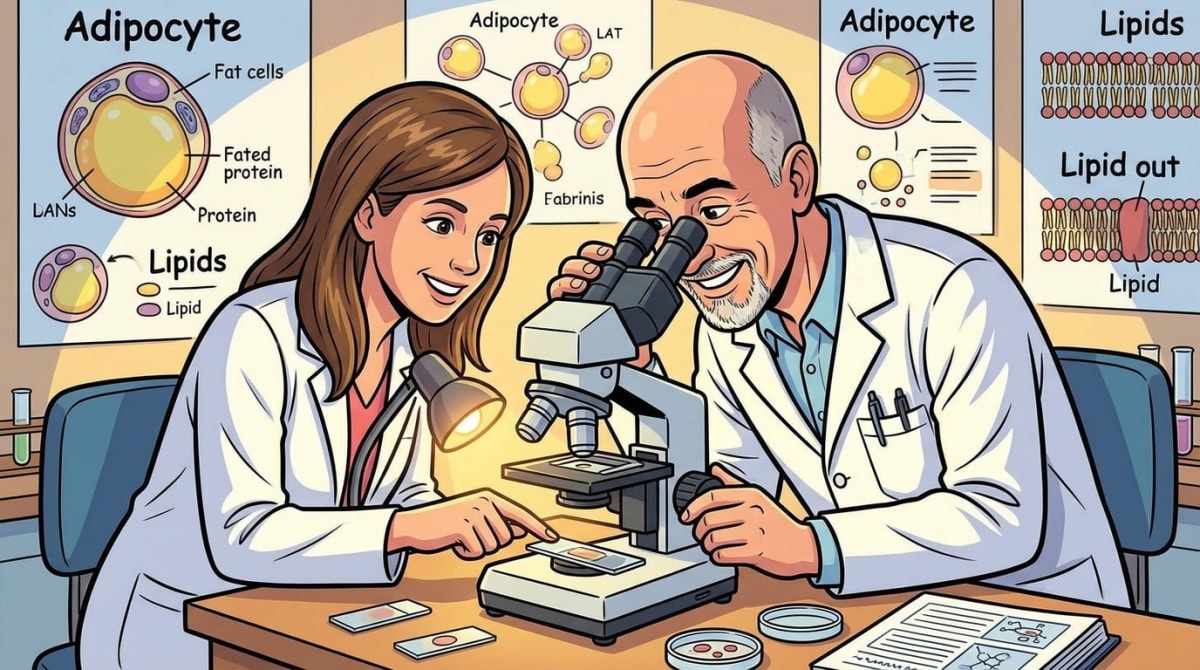
Why Belly Fat Gets Harder to Lose After 40 — Scientists Just Found the Biological Reason
The Short Version
- A previously unknown stem cell type called CP-A emerges during middle age and creates new belly fat cells at an accelerating rate — the clearest biological explanation yet for why visceral fat accumulates even when diet has not changed.
- CP-A cells are unusual: unlike almost every other adult stem cell, they become MORE active with age, not less — and transplant experiments confirm this capacity is encoded in the cells themselves.
- The LIFR receptor pathway drives CP-A activation; disrupting it in animal models significantly reduced new belly fat cell creation, making it a concrete target for future drug development.
- Visceral fat — the deep kind CP-A cells preferentially create — secretes inflammatory cytokines and is directly linked to accelerated insulin resistance, Type 2 diabetes, and cardiovascular disease.
- Strength training, adequate protein (1.2–1.6g per kg of body weight), and consistent sleep are the best-documented tools for countering visceral fat accumulation, each working through mechanisms that directly intersect with the biology CP-A research describes.
If you have noticed belly fat accumulating in your 40s despite no real change in how you eat or move, science just confirmed what you suspected: your body genuinely changed the rules. A study published in Science in April 2025 by researchers at City of Hope and UCLA identified a previously unknown stem cell type that emerges specifically during middle age and supercharges the production of new belly fat cells. For the first time, there is a clear biological answer to why you gain belly fat with age — and it has nothing to do with eating more.
The Discovery: A New Type of Stem Cell Wakes Up in Your 40s
Researchers named the newly identified cells CP-A — committed preadipocyte, age-enriched — a type of stem cell found in visceral fat tissue that becomes progressively more active during middle age. What makes them remarkable is how unusual their behavior is. Most adult stem cells follow a predictable pattern: their capacity to regenerate declines with age. CP-A cells do the opposite. As ScienceDaily's summary of the City of Hope and UCLA research put it, "while most adult stem cells' capacity to grow wanes with age, the opposite holds true with APCs."
In practical terms: the machinery for creating new belly fat cells ramps up precisely when most people expect their bodies to have slowed down.
The research team confirmed that this tendency is encoded in the cells themselves — not just a response to the hormonal environment of an aging body. In transplant experiments, APCs from older animals introduced into young mice generated large numbers of new fat cells. APCs from young animals transplanted into older mice generated relatively few. The age-specific capacity to create belly fat travels with the cells.
Importantly, analysis of human visceral fat tissue found that CP-A cell enrichment correlates strongly with donor age — suggesting the same age-driven mechanism is at work in humans, not just animal models.
What Are Adipocyte Progenitor Cells and Why They Turn Against You
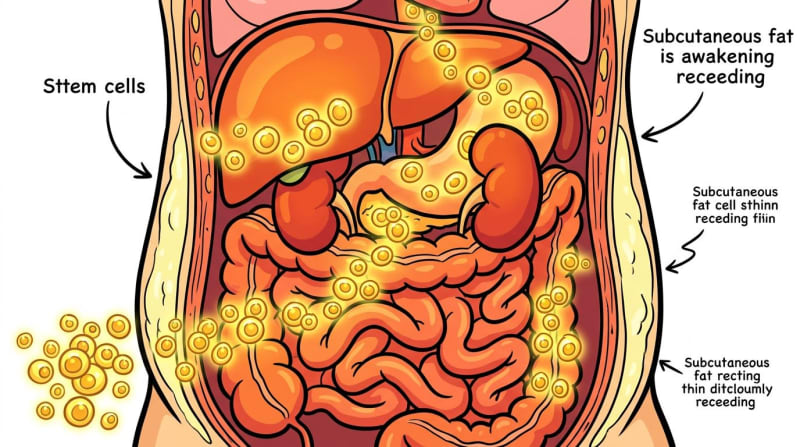
What Are Adipocyte Progenitor Cells and Why They Turn Against You
Adipose progenitor cells — APCs — are stem cells resident in fat tissue whose job is to differentiate into mature fat cells when the body signals that new ones are needed. In younger adults, these cells exist but remain largely dormant. Fat storage happens primarily through the expansion of existing fat cells, not the creation of new ones.
The Science paper found that this changes during middle age: adipogenesis — the process of generating brand-new fat cells — is "unlocked" in a way that simply does not happen at the same rate earlier in life. It is a distinct biological phase, not a gradual continuation of earlier fat patterns.
Where this matters most is in the visceral fat depot — fat that wraps around internal organs like the liver, intestines, and kidneys. This is different from subcutaneous fat, the kind just beneath the skin that you can pinch. Visceral fat is less visible and far more metabolically disruptive. As people age, research confirms a consistent redistribution: fat moves away from subcutaneous stores toward visceral, hepatic, muscular, and perivascular compartments — precisely where CP-A cells are most active. Here is how that shift plays out across the decades, based on established body composition research:
What does it mean that your body has a dedicated class of stem cells becoming more active precisely where fat is most metabolically disruptive?
The LIFR Pathway: The Biological Switch Behind Belly Fat Expansion

The LIFR Pathway: The Biological Switch Behind Belly Fat Expansion
The Science paper went further than identifying CP-A cells — it mapped the molecular mechanism that activates them. LIFR signaling — leukemia inhibitory factor receptor — was found to be indispensable for CP-A adipogenesis and visceral fat expansion. When researchers disrupted LIFR signaling in animal models, new belly fat cell creation dropped significantly. Remove the signal, and the cells cannot complete their work.
This is significant beyond the basic science. LIFR is a receptor pathway — the kind of molecular target that pharmaceutical programs are built around. Blocking or modulating a specific receptor is among the most well-established approaches in drug development, used in everything from autoimmune therapies to targeted cancer treatments.
This does not mean a LIFR-targeted drug is imminent. Translating a molecular finding into a clinical therapy typically takes a decade or more of safety testing, trials, and regulatory review. But identifying a specific, biologically essential pathway for visceral fat expansion in middle age is exactly the kind of foundational discovery that makes future therapies possible. As the Diabetes, Obesity & Metabolism review noted:
"Restoring adipose progenitor competence while preserving depot-specific metabolic identity may help slow age-related metabolic deterioration and prolong healthspan."
— Diabetes, Obesity & Metabolism, June 28, 2026
The groundwork is now laid.
Why This Is More Than Vanity: Visceral Fat and Metabolic Health
Why This Is More Than Vanity: Visceral Fat and Metabolic Health
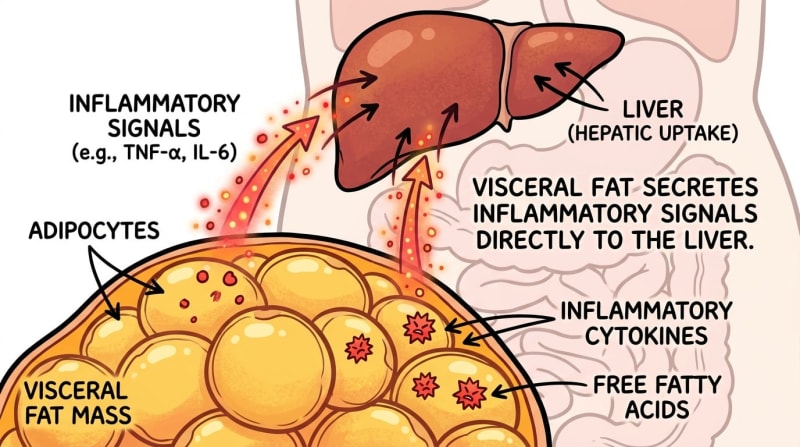
Belly fat is not a cosmetic issue. Subcutaneous fat — the kind you can pinch — is relatively metabolically inert. Visceral fat is biologically active: it secretes inflammatory cytokines, disrupts hormone signaling, and communicates directly with the liver in ways that drive chronic disease.
A June 2026 review in Diabetes, Obesity & Metabolism identified four interlocking defects in aging adipose tissue that drive this process: transcriptional reprogramming, sirtuin dysregulation, nuclear lamina remodeling, and senescent cell accumulation. The result is that fat increasingly redistributes toward visceral, hepatic, muscular, and perivascular compartments — and that redistribution accelerates insulin resistance, Type 2 diabetes, and cardiovascular disease. Aging adipose tissue does not just store fat differently; it changes its entire biological character.
Based on established large-cohort research, here is how visceral fat compares to subcutaneous fat across key health outcomes:
The belly fat you cannot see is the kind that matters most. And it is exactly what CP-A cells are wired to create.
What You Can Do Right Now: Diet and Lifestyle Strategies That Counter This Biology

What You Can Do Right Now: Diet and Lifestyle Strategies That Counter This Biology
Here is where the research becomes actionable. The biology is real — but it is not fixed. Several well-studied interventions specifically target visceral fat, and understanding the mechanism clarifies exactly why they work.
The most underutilized lever is strength training. Resistance training reduces visceral fat more effectively than aerobic exercise alone, and the mechanism makes sense: muscle tissue is metabolically active at rest, so building more of it raises your baseline energy expenditure and changes the hormonal environment that regulates fat storage. Multiple meta-analyses have documented this effect across exercise modalities:
protein does more than build muscle. Adults in middle age benefit from higher intakes — research suggests approximately 1.2 to 1.6 grams per kilogram of body weight per day to preserve lean mass and support satiety. Distributing protein across meals rather than concentrating it all in one sitting appears to maximize muscle protein synthesis, which matters increasingly after 40 as anabolic signaling becomes less efficient.
Sleep and stress are the levers most people skip — and they matter more than most people realize. Cortisol, the primary stress hormone, directly activates fat storage in visceral depots. Visceral fat carries a higher density of cortisol receptors than subcutaneous fat, which is why chronic stress and poor sleep send new fat precisely where you least want it. The relationship between sleep duration and cortisol elevation is well-documented across sleep research:
These are not peripheral lifestyle choices. They are direct biological inputs to the same system CP-A cells operate within.
The Bigger Picture: What This Research Changes About How We Talk About Belly Fat

The Bigger Picture: What This Research Changes About How We Talk About Belly Fat
For decades, conversations about middle-age belly fat have been framed as a failure of discipline. Eat less. Move more. The belly will respond. For some people in some circumstances, that framing carries modest truth. But millions of people in their 40s and 50s eat carefully, stay active, and still find visceral fat accumulating in ways that feel disconnected from their effort.
The CP-A discovery is some of the clearest evidence yet that this experience is real and has a distinct biological driver separate from caloric intake. The Science paper is not a permission slip to stop trying — the lifestyle interventions above are supported by real evidence and they work. But this finding is a meaningful correction to a conversation that has been weighted too heavily toward individual blame and too lightly toward biology.
Future research into the LIFR pathway may produce targeted therapies that work alongside diet and exercise. That research will take time. The more immediate value of this discovery is simpler: a shift in how we understand middle-age bodies. Not as bodies that have failed, but as bodies doing something specific, biologically real, and now finally visible.
The question worth staying with: what changes, practically and emotionally, when the difficulty you have been experiencing turns out to have been real all along?
Content ID: otEBvMphWslB3CK18Bo30teD
See an error? Tell us.
Keep Reading

What North Carolina's New Food Is Medicine Coalition Reveals About Building State Coalitions from Scratch

What the New FIMC Multi-State Evidence Report Reveals About FIM Cost Savings — and Why High-Acuity Patients Are the Key

Child Care Is the Largest Untapped FIM Delivery Platform — A New Report Shows What's Missing
Comments
Share with the Community