

What the New CHCS Policy Framework Means for FIM Officers and Medicaid Programs
The Short Version
- Diet-related conditions generate over $1.1 trillion in annual U.S. healthcare costs — Medicaid programs bear a growing share, making Food Is Medicine Medicaid policy a fiscal priority, not just a health equity aspiration.
- The July 2026 CHCS State Policy Pathways brief maps existing Medicaid authorities for medically tailored meals, produce prescriptions, and nutritional counseling — authority most states already hold but haven't fully deployed.
- Scaling medically tailored meals to all eligible Americans could reduce annual healthcare spending by $13.6 billion, according to Rockefeller Foundation estimates — one intervention against a trillion-dollar cost burden.
- FIM programs have stalled not for lack of evidence but for lack of dedicated staff; the FIM State Officer Program, launched January 2026, addresses that gap with three years of funding and full wraparound support including one-on-one coaching and a national peer hub.
- Only 13% of Americans have heard of Food Is Medicine programs — but more than 4 in 5 support expanding food and nutrition benefits in healthcare once they understand what FIM does, giving policymakers substantial political cover.
The July 2026 CHCS policy brief arrives with what most practitioners in Food Is Medicine Medicaid policy have been waiting for: a usable map of the existing terrain. States hold meaningful Medicaid authority to fund medically tailored meals, produce prescriptions, and nutritional counseling — authority most haven't fully deployed. The State Policy Pathways brief from CHCS names that authority and shows how states are using it. The new FIM State Officer Program adds the institutional capacity to act on it.
The Urgency: Diet-Related Disease Is Straining State Medicaid Budgets
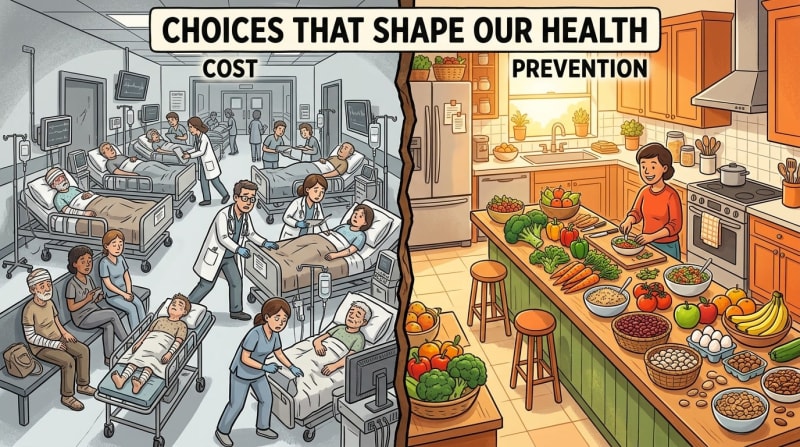
The Urgency: Diet-Related Disease Is Straining State Medicaid Budgets
According to the CHCS State Policy Pathways brief, diet-related conditions drive over $1.1 trillion in annual U.S. healthcare costs. For Medicaid directors, this is not an abstract public health statistic — it's a budget reality. The populations most heavily represented in Medicaid are also the populations most affected by diabetes, hypertension, and cardiovascular disease, all conditions that food and nutrition interventions can meaningfully modify.
For state health agencies, the question is no longer whether food is medicine. The more useful question is what it costs to keep treating diet-related disease at the back end — in emergency departments and inpatient wards — when the evidence for front-end nutritional intervention is solid and the Medicaid authority to fund it already exists.
What the New CHCS Brief Actually Maps Out
What the New CHCS Brief Actually Maps Out
The State Policy Pathways for Advancing Food and Nutrition Strategies to Improve Health brief, published by CHCS in July 2026, introduces a framework for coordinated cross-sector action on food and nutrition in Medicaid. Its core contribution is not creating new authority — states already have more than most have used. It maps what exists in a form practitioners can act on.
The framework identifies key policy levers, state authorities, and best practices, organized around three target populations: adults with complex health and social needs; individuals with health-related social needs more broadly; and population health and prevention contexts where FIM can operate at scale before conditions become acute. That segmentation is load-bearing for implementation. A medically tailored meals benefit for a dual-eligible adult with advanced kidney disease is not the same program as a produce prescription for a Medicaid-enrolled child at risk for obesity. Matching the right intervention to the right population — and the right coverage mechanism — is exactly what this framework helps practitioners do.
What specific Medicaid authorities are most states sitting on but haven't operationalized — and which ones require federal waiver versus plan-level action?
The Core Food Is Medicine Interventions: What Medicaid Programs Are Actually Covering
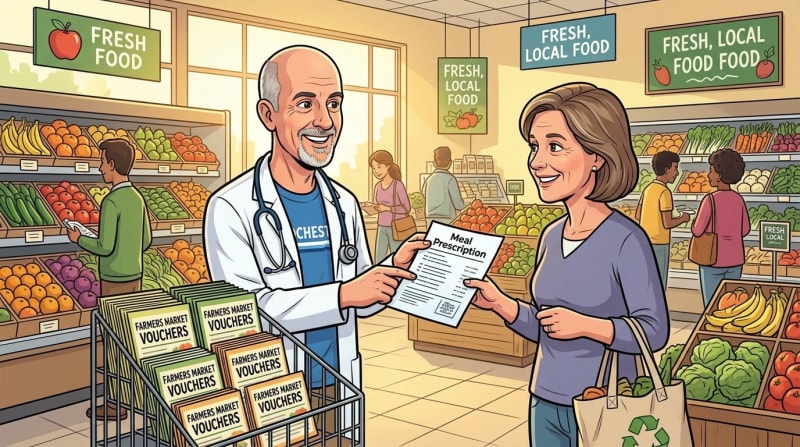
The Core Food Is Medicine Interventions: What Medicaid Programs Are Actually Covering
CHCS defines Food Is Medicine as the integration of diet and nutrition supports into traditional health care to help manage and prevent chronic, diet-related conditions including obesity, diabetes, and cardiovascular disease. In Medicaid coverage terms, three interventions anchor that definition.
Medically tailored meals are clinician-prescribed, diet-specific meals for individuals with complex medical needs — therapeutic nutrition as a covered clinical service, not meal delivery. The Rockefeller Foundation estimates that if medically tailored meals reached all eligible Americans, annual healthcare spending could be reduced by $13.6 billion. That figure comes from clinical evidence in programs already operating, scaled to population level.
Produce prescriptions are provider-issued vouchers for fresh fruits and vegetables, redeemable at participating grocers and farmers markets. These programs are often the fastest FIM benefit to implement through Medicaid managed care plans — particularly as a value-added service or alternative benefit plan component — because they don't require state plan amendments in every configuration.
Nutritional counseling is reimbursable under multiple Medicaid benefit categories as a preventive or chronic-care service. It's frequently the most underutilized of the three — not because the authority is unclear, but because states haven't always built the reimbursement infrastructure to make it accessible in practice.
The cost case for building that infrastructure is straightforward. Here is the scale of what is at stake:
The $13.6 billion in potential savings from medically tailored meals alone represents one intervention against a $1.1 trillion cost burden. The gap between those two numbers is also the opportunity for produce prescriptions and nutritional counseling to compound.
The FIM State Officer Model: Why Staffing Is the Missing Piece
The FIM State Officer Model: Why Staffing Is the Missing Piece
The FIM State Officer Program, launched in 2026 by CHCS and the Rockefeller Foundation, funds states to hire a dedicated FIM officer for three years. It is backed by the Food is Medicine Impact Fund — a joint initiative of The Rockefeller Foundation and Builders Vision, hosted by RF Catalytic Capital.
The support package matters as much as the funding itself. Participating states receive virtual and in-person onboarding, one-on-one coaching, stakeholder engagement support, and access to a national FIM State Officer Hub for peer learning with officers in other states. That wraparound infrastructure is the model worth examining — not just the officer position.
FIM programs in many states have stalled not from lack of evidence but from lack of dedicated staff inside state agencies to navigate the cross-agency work. Medicaid, public health, agriculture, and managed care plans all have roles in a functional FIM system. Someone has to sit at the intersection of those agencies, build the referral pathways, maintain the provider relationships, and track what is actually working. The state officer model places that person inside state government, where the policy levers are.
What would it take to make the state officer model self-sustaining after the three-year grant period ends — and which states are already building for that transition?
Making FIM Durable: Integrating with SNAP, WIC, and the Existing Safety Net

Making FIM Durable: Integrating with SNAP, WIC, and the Existing Safety Net
The CHCS brief is direct on this point: FIM works best when it is strategically layered with the existing nutrition assistance infrastructure, not positioned as an alternative to it. SNAP and WIC aren't gaps that FIM fills — they're the foundation that makes FIM interventions durable.
When integrated with the existing food safety net, CHCS reports that FIM has demonstrated capacity to decrease emergency department use, lower healthcare costs, and support long-term healthy eating for improved health outcomes. That ROI case gives Medicaid directors the internal justification to pursue coverage expansions — and it's strengthened, not weakened, by showing that FIM extends what SNAP and WIC already do rather than duplicating it.
Practical integration points include SNAP Employment and Training programs as a channel for cooking skills and nutrition education; WIC referral pathways into produce prescription programs; and community benefit requirements on health systems as local co-funders for FIM initiatives. None of these require new federal authority. They require someone in state government with the time, relationships, and mandate to build the connections — which is exactly what the state officer program funds.
Here is what the American public says about whether this direction is right:
A June 2025 nationally representative survey by Hattaway Communications for the Rockefeller Foundation — covering 2,271 respondents across all 50 states — found that only 13% of Americans had heard of Food Is Medicine programs before taking the survey. After learning what FIM is, more than four in five said they believe U.S. healthcare should offer more food and nutrition programs to address and manage illness.
That gap — between 13% awareness and 82% support — is not a problem for FIM programs. It is evidence that once people understand what Food Is Medicine Medicaid policy actually does, they are already on board. The programs aren't waiting for public permission. The public is waiting for the programs.
Content ID: 02SPSHdNBeFFc9zKrbVU71ug
See an error? Tell us.
Keep Reading

What North Carolina's New Food Is Medicine Coalition Reveals About Building State Coalitions from Scratch
What the New FIMC Multi-State Evidence Report Reveals About FIM Cost Savings — and Why High-Acuity Patients Are the Key
Child Care Is the Largest Untapped FIM Delivery Platform — A New Report Shows What's Missing
Comments
Share with the Community