

Vitamin C Isn't Just for Colds: What a New Brain MRI Study Found in 2,000 Older Adults
The Short Version
- A June 2026 PLOS One study of 2,044 older Japanese adults found consistent links between lower blood vitamin C levels and reduced gray matter volume — measurable structural change in the brain, not just a mood or energy dip.
- The default mode network — the brain circuit active during memory, daydreaming, and self-reflection — showed weaker connectivity in participants with lower vitamin C, and is among the first networks disrupted in early cognitive decline.
- The brain uses roughly 20% of the body's total oxygen despite being 2% of its weight, making it unusually vulnerable to oxidative stress; vitamin C crosses the blood-brain barrier and gets actively concentrated in brain tissue.
- Red bell peppers deliver about 190mg of vitamin C per cup — more than twice the daily RDA — and summer farmers market produce more broadly is the easiest path to hitting the consistent daily intake the body requires.
- Vitamin C is water-soluble and not stored by the body, so the 75–90mg daily RDA requires consistent daily intake; smokers need an additional 35mg per day due to accelerated oxidative depletion.
- This was observational research — an association was found, not causation — but the biological mechanisms connecting vitamin C to neurotransmitter production and oxidative protection in the brain are independently well-established.
Walk through a farmers market in early July and you'll find red bell peppers in brilliant stacks, strawberry quarts moving fast before 9am, and zucchini in lengths that challenge your dinner plans. You've always known this produce is good for you. What a study published this June in PLOS One adds is a more specific reason to pay attention — one that repositions vitamin C brain health as something worth thinking about far beyond cold season.
Most of us learned vitamin C as the nutrient in oranges that prevents scurvy and helps fight colds. The new research suggests that picture is incomplete. Researchers following 2,044 older adults found consistent associations between plasma vitamin C levels and how well the brain's structure held up over time. That's a different conversation than the one we grew up with.
What the 2,044-Person Study Found

What the 2,044-Person Study Found
Researchers at Hirosaki University in Japan recruited 2,044 adults over age 64, drew blood to measure plasma vitamin C levels, and ran MRI brain scans. What they found, reported by ScienceDaily, was a consistent pattern: participants with lower plasma vitamin C showed reduced gray matter volume and weaker connectivity within the default mode network — a critical brain circuit tied to memory, self-reflection, and rest-state processing.
This wasn't a self-reported questionnaire. It was objective brain imaging on more than 2,000 people, with the association holding even after researchers controlled for age, education level, and physical activity.
As co-author Tomohiro Shintaku put it: "Higher plasma vitamin C levels are associated with better preserved structural connectivity of the default mode network."
The critical caveat, stated clearly by the research team, is that this was observational research — they could not determine whether vitamin C directly causes these differences in brain structure. The finding is an association, not a proven mechanism. That's an honest boundary. It's also worth noting that a study of this scale, using brain imaging, with those controls in place, is meaningful signal even without causation established.
Not everyone maintains adequate vitamin C levels consistently. National nutritional surveys summarized by the NIH find that deficiency is more common in specific groups — older adults, smokers, and those with limited fruit and vegetable access — while remaining a background concern across the general population.
What would it mean to learn that a nutrient this easy to obtain might be quietly connected to how well your brain holds its structure over time?
What Gray Matter and the Default Mode Network Actually Are

What Gray Matter and the Default Mode Network Actually Are
Gray matter is where the neurons live. It's the processing layer of the brain — responsible for memory, decision-making, sensory perception, and the kind of thinking that makes you recognize a face, follow a conversation, or weigh a choice. Gray matter volume naturally declines with age, and that process varies considerably depending on genetics, physical activity, and — increasingly, researchers suggest — nutrition.
The default mode network is less familiar by name, but you know it in practice. It's the brain circuit that activates when you're at rest: daydreaming, recalling a memory, thinking about someone you care about. When you let your mind wander, the default mode network is working. It's also one of the first networks disrupted in early cognitive decline — changes in DMN connectivity appear among the earliest structural signals researchers watch for in Alzheimer's research.
Weaker connectivity within the default mode network, alongside reduced gray matter volume, is exactly what the PLOS One study found associated with lower vitamin C levels. Loss of gray matter volume is a recognized, measurable marker of brain aging. Finding a common dietary nutrient linked to that measure is part of what makes this study worth sitting with.
The connection between something as ordinary as a bell pepper and something as complex as neural network connectivity is part of what makes nutrition science continue to surprise.
Why Vitamin C Might Matter for Brain Structure
Why Vitamin C Might Matter for Brain Structure
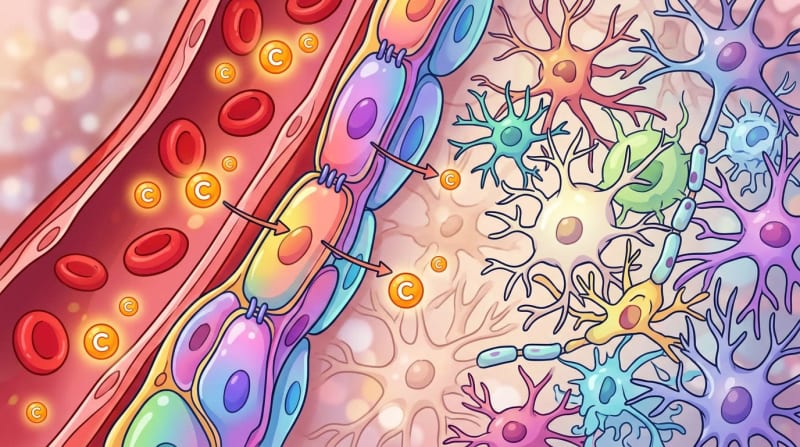
The biology behind this association isn't mysterious. The Harvard T.H. Chan School of Public Health's Nutrition Source explains that vitamin C is involved in producing the hormones and chemical messengers used in the brain and nerves — neurotransmitters, in practical terms. Without sufficient vitamin C, that production is impaired.
There's also the oxidative stress angle. The brain is metabolically intense in a way most people don't fully appreciate — it accounts for roughly 20% of the body's total oxygen consumption despite representing only about 2% of body weight. That metabolic demand generates oxidative stress, and the brain is particularly vulnerable to it. Vitamin C is one of the body's most effective antioxidants, and critically, it crosses the blood-brain barrier — it doesn't simply circulate in the blood but gets actively concentrated in brain tissue.
Those two mechanisms — supporting neurotransmitter synthesis and protecting against oxidative damage — give vitamin C a more intimate relationship with brain function than its reputation as a cold-season supplement suggests. The observational finding from PLOS One doesn't prove this mechanism is at work, but it's consistent with the established biology.
How Much Vitamin C You Actually Need — and Why Many People Fall Short

How Much Vitamin C You Actually Need — and Why Many People Fall Short
The recommended dietary allowance is 75mg per day for adult women, 90mg per day for adult men. That's achievable through food — a single cup of strawberries gets you close. But there's a feature of vitamin C that many people don't account for: it's water-soluble, and the body doesn't store it. Whatever you don't use gets cleared out daily. The RDA isn't an amount you can bank — it's an amount you need to hit consistently, day after day.
Some groups need significantly more. Smokers require an additional 35mg per day because tobacco smoke increases oxidative stress and accelerates vitamin C metabolism. High-stress periods and illness also deplete it faster. The people most likely to run short are often those already carrying the most physiological load.
What about supplements? The research community generally favors food-first approaches — not because supplements don't deliver vitamin C, but because whole foods bring vitamin C alongside other compounds (bioflavonoids, fiber, carotenoids in the case of peppers) that work together in ways an isolated supplement doesn't replicate. The bell pepper and the 500mg tablet both raise plasma vitamin C. The bell pepper also gives you a reason to make dinner something worth eating.
Is hitting 75–90mg something you're actually doing most days — or is it something you assume you're doing without checking?
Summer's Best Food Sources of Vitamin C
Summer's Best Food Sources of Vitamin C
This is where July does most of the work for you.
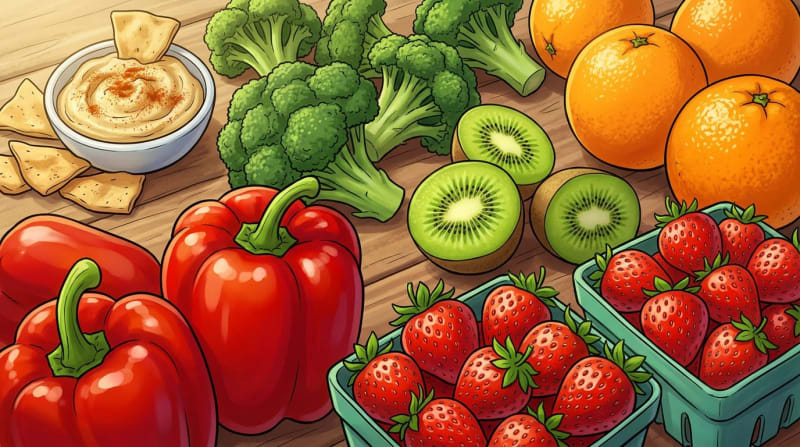
Red bell peppers sit at the top of the vitamin C chart across the entire food supply. A single cup of raw red bell pepper delivers around 190mg of vitamin C — more than twice the daily RDA for most adults — in a food that's at peak quality right now. Roasted, sliced into salads, stuffed, eaten raw with hummus — the form barely matters. The nutrition is consistent.
Strawberries are a standout for summer: a cup of fresh strawberries delivers roughly 85mg, nearly a full day's RDA in one bowl. Farmers market strawberries in early July are sweeter and more fragrant than what travels across the country. Eat them fresh while the season holds.
Broccoli, available year-round but easy to overlook in summer, delivers around 81mg per cup raw. Kiwi (about 64mg each) and oranges (around 70mg each) round out the reliable year-round options. Between the summer peaks and the standbys, hitting 75–90mg daily doesn't require a plan — it requires having produce on hand.
The vitamin C story in summer is really a color story. The orange, red, and yellow fruits and vegetables — the ones that make a plate look alive — tend to be the concentrated sources. If your plate has genuine color in it most days, you're probably doing better than you think.
What This Actually Means for Your Plate
What This Actually Means for Your Plate
No radical change is needed here. The PLOS One research points to plasma vitamin C as a marker associated with brain structural health — and the path to consistent vitamin C is already on summer farmers market tables, in grocery produce sections, in meals most people are already making.
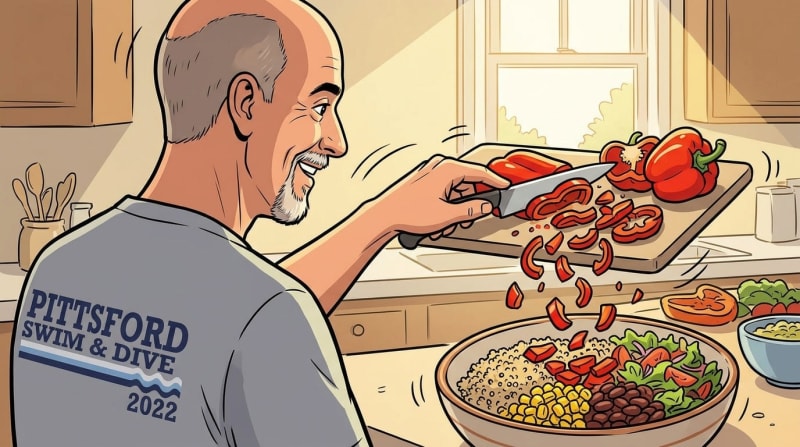
What the research adds is intention. The person slicing red peppers into a grain bowl, eating strawberries with breakfast, keeping a bowl of kiwis on the counter — that person is, according to this study's logic, already building something. Not preventing disease through heroic dietary discipline. Maintaining a pattern that a growing body of research suggests matters more than we knew.
"Vitamin C isn't something you need to go looking for. It's already in the food that tastes the best this time of year."
The gift of summer produce is that it makes this easy. The farmers market is doing this work whether or not you know the neuroscience behind it. What the study does is name what's already happening — and invite you to be more deliberate about a habit you may already have.
Add color where it already makes sense. Let July's produce do what it was going to do anyway. The vitamin C brain health conversation doesn't require a new behavior — it requires noticing the one you already have, and maybe being a little less casual about it.
What would change for you if you started thinking of your summer eating habits as a brain health practice, not just a food preference?
Content ID: RSMrnR4Mep0NdC0pjdqIQDYX
See an error? Tell us.
Keep Reading

What North Carolina's New Food Is Medicine Coalition Reveals About Building State Coalitions from Scratch

What the New FIMC Multi-State Evidence Report Reveals About FIM Cost Savings — and Why High-Acuity Patients Are the Key

Child Care Is the Largest Untapped FIM Delivery Platform — A New Report Shows What's Missing
Comments
Share with the Community