
The Brighton Farmers Market SNAP Match: How $2 Becomes $4 for Fresh Local Produce
The Short Version
- Brighton Farmers Market's 1:1 SNAP match turns every $2 of EBT benefits into $4 of buying power for fresh produce — no application, no enrollment, just show up with your EBT card on Sunday morning.
- Only about 1 in 10 American adults consumes enough vegetables daily; SNAP nutrition incentive programs are among the few interventions documented to actually move that number for participants.
- Rochester's city poverty rate runs near 30%, more than double the national average — making programs like Brighton's SNAP match structural food infrastructure, not a charitable add-on.
- Brighton's 50+ vendors offer genuine seasonal variety from spring greens in May through winter squash in October, all reachable with matched SNAP tokens at no extra cost to the shopper.
- Foodlink anchors Rochester's broader food access ecosystem, and the simplest contribution anyone can make is telling one person who doesn't yet know this program exists.
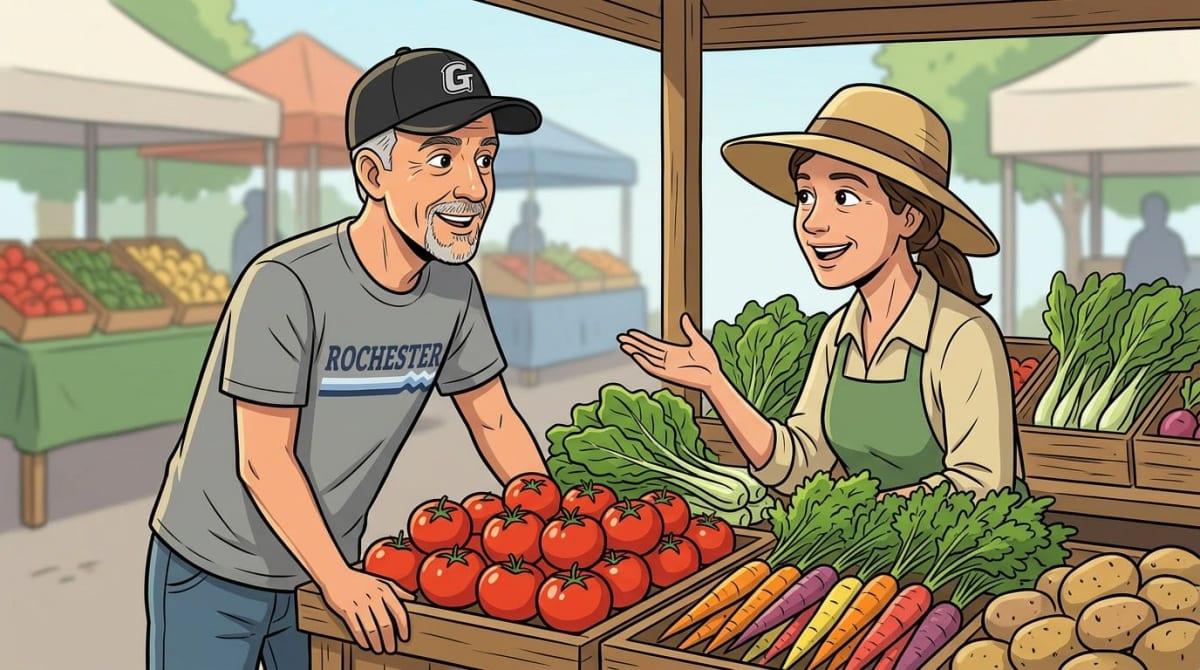
Sunday mornings on Monroe Avenue, between May and November, something shifts. The parking lot at Brighton Town Hall fills early. The canopies go up. More than 50 vendors set out what they spent the week growing, fermenting, baking, and raising. It looks, on the surface, like a shopping trip. It functions as something else.
What most people don't know — or haven't heard clearly enough — is that if you pay with a SNAP EBT card at Brighton, your money goes further than it does anywhere else you shop for food. Brighton Farmers Market runs one of Rochester's strongest SNAP match programs: for every $2 you spend with EBT benefits, the market adds $2 in tokens for fresh produce. That's not a coupon. That's a structural shift in who gets to bring home a bag of heirloom tomatoes or a quart of local strawberries.
The SNAP EBT farmers market Rochester NY connection isn't well-advertised. That's the gap this piece is here to close.
How the SNAP Match Works at Rochester Farmers Markets
How the SNAP Match Works at Rochester Farmers Markets
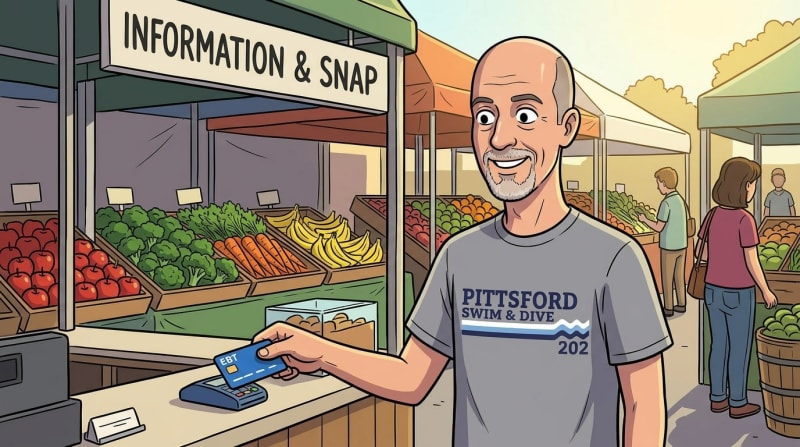
The mechanics are simple. When you arrive at Brighton Farmers Market, head to the market information booth. Swipe your EBT card for any amount you want to spend. The market adds the match in tokens, redeemable specifically for fresh fruits and vegetables at any participating vendor.
Your $2 of benefits becomes $4 of buying power. No application. No enrollment process. If you have an EBT card, you're eligible.
Brighton runs Sundays from 9 AM to 1 PM, May through November. The market is at the Brighton Town Hall on Monroe Avenue — central to the Brighton-Pittsford corridor and accessible from much of Rochester's south side.
Other Rochester-area farmers markets have also expanded SNAP access. The Rochester Public Market, one of the largest year-round public markets in New York State, accepts SNAP/EBT directly. The national Double Up Food Bucks network — which operates SNAP match programs in more than 25 states — has been the model for programs like Brighton's. If you visit any farmers market in the region, ask at the information table; the number of markets accepting EBT has grown steadily over the past decade. What used to be a single-market option is becoming a regional infrastructure.
What You Can Actually Buy
What You Can Actually Buy
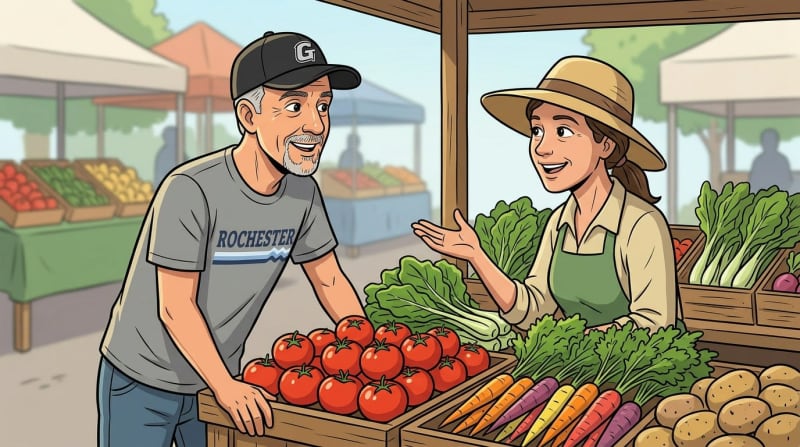
Fifty-plus vendors changes the question from "can I find produce?" to "which farm do I want it from?"
Brighton's roster runs deep: organic vegetable farms, specialty mushroom cultivators, cut flower growers, herb producers, fermented food makers — kimchi, krauts, hot sauces — alongside artisan bakers and seasonal produce specialists. The match tokens cover fresh fruits and vegetables specifically, which means the program is designed precisely for the foods that make the biggest nutritional difference.
Here is how the seasonal growing calendar typically unfolds at Brighton and other Rochester-area markets:
In May and June, the early market offers asparagus, spring greens, radishes, pea shoots, and the first strawberries of the season. July through August brings the full summer rotation: tomatoes in every size and color, sweet corn, cucumbers, zucchini, eggplant, blueberries, peaches. September and October shift into the deep-root season — winter squash, sweet potatoes, beets, Brussels sprouts, kale that gets sweeter as the nights cool.
A $20 SNAP match at Brighton creates real purchasing power: a pound of mixed greens, two pounds of tomatoes, a bag of apples, a head of cabbage, a bunch of beets. That's a week of vegetable variety from a single Sunday morning, sourced from farms you can talk to directly about how the food was grown — and that conversation, the one between grower and shopper, is part of what makes a farmers market something different from a grocery store errand.
What do you reach for first when the barrier isn't cost?
Why This Matters for Health
Why This Matters for Health
The case for fresh produce isn't complicated. What's complicated is access.
According to the CDC's Behavioral Risk Factor Surveillance System, only about 1 in 10 American adults consumes enough vegetables daily, and roughly 12% meet recommended fruit intake. Both numbers are lower for people with lower incomes — where price and proximity stack against variety. The research on what changes when access improves is consistent: when low-income families can afford more fresh produce, they buy it.
Programs like Brighton's SNAP match are part of a federal nutrition incentive framework. Research compiled by the USDA's Gus Schumacher Nutrition Incentive Program (GusNIP) — the federal grant program that funds SNAP incentives at markets nationwide — documents that nutrition incentive programs consistently increase fresh fruit and vegetable consumption among participants. The effect is largest among people who faced the greatest access barriers before the program.
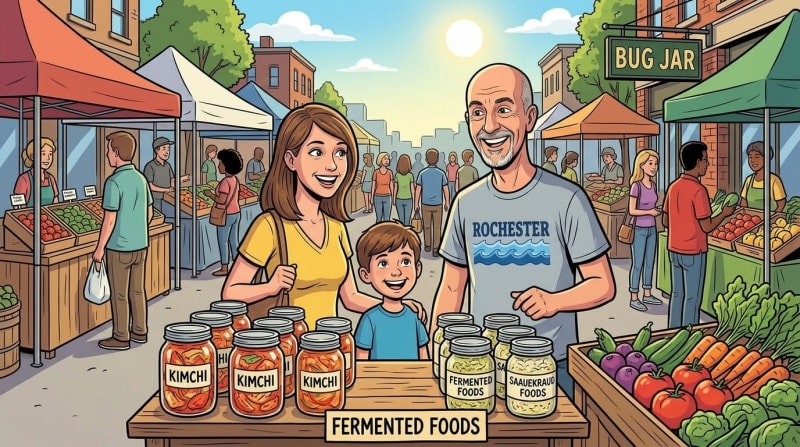
The gut microbiome piece is worth naming directly: diverse plant foods — different colors, textures, and fermented preparations — feed different microbial populations in ways that processed grocery alternatives don't replicate. A farmers market with seasonal rotation and 50 vendors offers exactly that range. The kimchi and krauts available at Brighton add a live-culture dimension that a grocery store refrigerator shelf rarely matches for freshness or variety. The science on dietary diversity and microbiome health is still developing, but the direction is consistent: the more different plant foods, the better.
Cost is the barrier this program is built to remove. The question shifts from "can I afford this?" to "what do I want to cook this week?" That's a different relationship with food — one that belongs to everyone.
The Bigger Picture: Food Equity in Rochester
The Bigger Picture: Food Equity in Rochester
Rochester is one of the most economically divided cities in the United States. That fact has consequences for who gets to eat well.
According to the U.S. Census Bureau's American Community Survey, Rochester's city poverty rate runs near 29–30%, more than double the national average and more than double the rate for Monroe County as a whole. Feeding America's Map the Meal Gap places Monroe County food insecurity above national benchmarks, with the highest rates concentrated in the city's urban core. These aren't abstractions. They are the context in which a 1:1 SNAP match at a farmers market becomes infrastructure — not a perk, not a pilot program, infrastructure.
The assumption that farmers markets serve affluent shoppers is, historically, often accurate — and it's the gap programs like Brighton's are working to close. A market with 50+ vendors, running Sunday mornings in a central location, accepting EBT with a 1:1 match, is a different kind of institution than the stereotype suggests. When it's working, it belongs to the whole community.
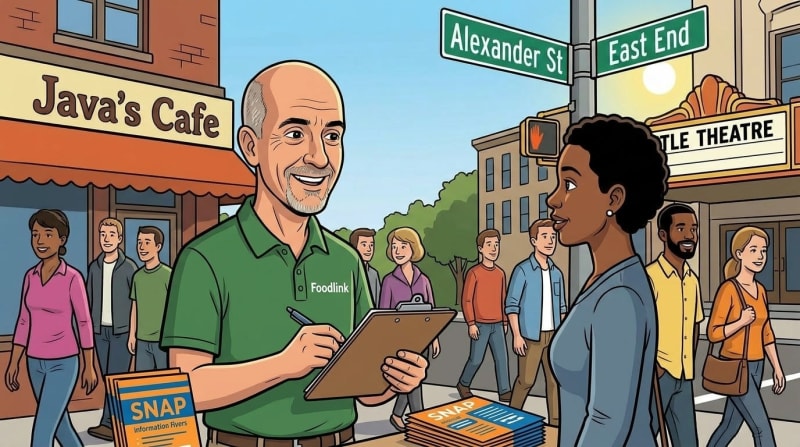
Foodlink operates as the hub of Rochester's food access ecosystem — food rescue, SNAP outreach, community health education, and partnerships with markets like Brighton. They serve tens of thousands of people across the Greater Rochester region annually. Brighton's SNAP match doesn't exist in isolation; it's one working piece of a connected network of organizations building the infrastructure through which a community feeds itself.
"Food access is not a gift handed down. It is infrastructure built together."
What readers can do is simple and doesn't require a donation. Tell one person who doesn't know. A neighbor, a coworker, a family member who shops with EBT. The match program only works when people show up to use it — and people only show up when they know it exists.
If you have capacity to contribute — Foodlink accepts donations and volunteers year-round. These organizations are doing structural work, building the channels through which a community feeds itself, one Sunday morning at a time.
What would it mean for Rochester if every family that qualified for this match actually knew about it and used it? That's not a hypothetical. It's an invitation.
Content ID: nHjAJRdcdAYBgCUEMoWPFvAY
See an error? Tell us.
Keep Reading
What North Carolina's New Food Is Medicine Coalition Reveals About Building State Coalitions from Scratch
What the New FIMC Multi-State Evidence Report Reveals About FIM Cost Savings — and Why High-Acuity Patients Are the Key
Child Care Is the Largest Untapped FIM Delivery Platform — A New Report Shows What's Missing
Comments
Share with the Community