

Which Type of Kombucha Is Actually Healthiest? New Research Has an Answer
The Short Version
- Green and oolong tea kombuchas showed the highest antioxidant activity in a new head-to-head study of five tea types — a meaningful difference from the black tea base used in most commercial brands.
- The tea you start with sets the biological ceiling for what the finished kombucha can be — the SCOBY metabolizes the polyphenols already in the tea, it doesn't create them.
- Most commercial kombuchas use black tea; the tea base appears quietly in the ingredient list, not the front label — thirty seconds of label-reading changes the purchase.
- Kombucha's acetic acid is antimicrobial regardless of tea type, but antioxidant and catechin-derived benefits are directly tied to how much the starting tea preserved through processing.
- For home brewers, choosing a quality green or oolong tea base is the single highest-leverage decision — ahead of flavorings, SCOBY age, or fermentation time.
Most of us pick kombucha by flavor. Ginger-lemon if we want something sharp, raspberry if we want something sweeter, watermelon if we're feeling adventurous. A few of us check the probiotic count on the label. Almost none of us look at what tea it started as — and according to a new peer-reviewed study published in Food Chemistry by researchers at Wroclaw Medical University, that detail turns out to be the most important variable in determining which kombucha is healthiest.
This is good news, not a correction. If you already drink kombucha, you're already doing something worth doing. What the research offers is a clearer view of how to make that same habit deliver more.
What Actually Happens When Tea Becomes Kombucha

What Actually Happens When Tea Becomes Kombucha
The transformation from sweet brewed tea to tart, fizzy kombucha is driven by a SCOBY — symbiotic culture of bacteria and yeast — working in two stages. First, yeasts convert sugars into alcohol and carbon dioxide. Then bacteria convert that alcohol into organic acids, primarily acetic acid and gluconic acid, which give kombucha its characteristic tang and a meaningful share of its antimicrobial properties.
What makes the tea base matter is what the SCOBY cannot create on its own. It metabolizes what is already in the tea. As Assoc. Prof. Helena Moreira, PhD, of Wroclaw Medical University put it: "Individual teas differ in their content of polyphenols, catechins, caffeine, and other bioactive compounds, which are subsequently metabolized by SCOBY microorganisms." The tea sets the ceiling for what fermentation can produce. A SCOBY fermenting green tea — rich in catechins, including the antioxidant EGCG — works with fundamentally different raw material than the same SCOBY fermenting black tea, where most of those catechins were oxidized during tea processing long before fermentation began.
According to research compiled by the Linus Pauling Institute at Oregon State University, catechin levels in brewed tea vary dramatically by type — a direct reflection of how much polyphenol content survived the way the leaf was processed:
If the SCOBY is the craftsperson, the tea is the raw material. What gets made is only as good as what you start with. What does it mean to choose that starting material thoughtfully — even when the label doesn't draw your attention to it?
The Five Tea Types and What Scientists Found
The Five Tea Types and What Scientists Found
The Wroclaw team brewed kombuchas from five teas — black, green, white, oolong, and pu-erh — under identical, controlled conditions and measured what each fermentation produced. It is the kind of head-to-head test that should have existed long before health claims started appearing on every bottle.
The differences they found were not minor. The research team noted that "the most surprising aspect was the scale of changes occurring during fermentation and how strongly they depended on the type of tea used." The tea base, they concluded, "acts as a specific matrix that shapes the course of fermentation and the final composition of kombucha."
Each tea brought a distinct molecular fingerprint to the process. Black tea — the most common commercial kombucha base — is fully oxidized during processing, converting most of its catechins into theaflavins and thearubigins. These are still antioxidant compounds, but they behave differently from unoxidized catechins. Green tea arrives with its catechins largely intact. Oolong, partially oxidized, falls between them. White tea, made from young leaves with minimal processing, preserves a solid polyphenol profile. Pu-erh — already microbially fermented before it ever meets a SCOBY — arrives with the most transformed and complex chemistry of the five.
Here is how much of the original leaf's catechin content survives each processing method before fermentation even begins — the input that shapes everything the SCOBY produces:
Five different starting materials. Five different fermentation trajectories. Five different biological profiles in the bottle.
Green and Oolong Emerged as the Most Biologically Active
Green and Oolong Emerged as the Most Biologically Active
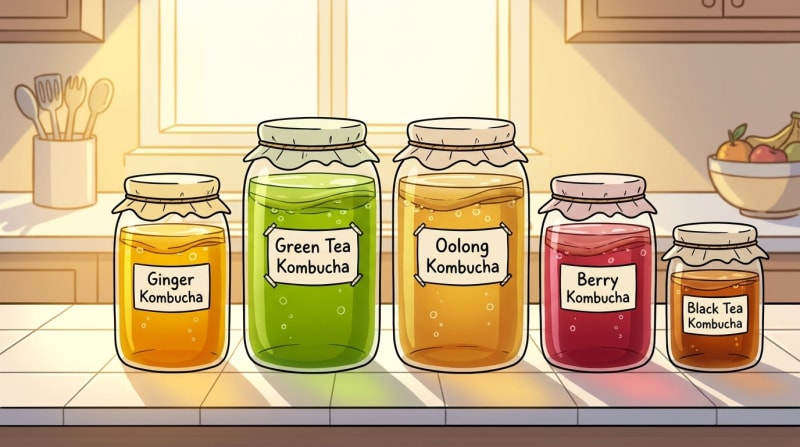
When the researchers measured antioxidant activity across all five finished kombuchas, green and oolong came out highest. These varieties also showed elevated levels of linalool and 2-phenylethanol — aromatic compounds with floral character and documented bioactive properties. The fermentation process, working from a richer starting substrate, concentrated or preserved these compounds more effectively in green and oolong kombuchas than in the other three.
Oolong is worth singling out because it tends to get overlooked in these conversations. Its partial oxidation places it in an interesting position: enough catechin preservation to deliver meaningful antioxidant activity, but enough processing complexity to develop a more approachable, nuanced flavor than most green teas. If this research holds up in follow-up studies, oolong kombucha may be the most underrated option on the market.
None of this makes black-tea kombucha without value. The fermentation process — regardless of tea type — produces acetic acid and supports the bacterial cultures that give kombucha its probiotic character. What differs by tea base is primarily the antioxidant ceiling: how much polyphenol-derived biological activity the finished drink can deliver. The tartness, the fizz, the organic acids — those come from the SCOBY. The potential advantage of green and oolong kombucha comes from the tea.
If the tea base matters more than most labels acknowledge, what else are we missing in the fermented foods we've already decided to trust?
What We Know About Kombucha's Health Benefits (and What We Don't)

What We Know About Kombucha's Health Benefits (and What We Don't)
Let's be honest about where the science stands. Most of the health research on kombucha comes from lab and animal studies. The large, well-controlled human trials that would definitively confirm benefits for people are still limited. That gap between what the marketing implies and what the science has actually confirmed is real, and it's worth naming plainly.
What the evidence does show: when made with green tea, kombucha carries antioxidants linked to blood sugar regulation, liver protection, and reduced cardiovascular risk — benefits associated with green tea's established catechin profile, which appears to carry through fermentation at least in part. The Wroclaw research adds to this picture by showing that green and oolong bases preserve the most of those compounds through the fermentation process itself.
Kombucha's acetic acid has shown antimicrobial activity against bacteria including E. coli and Salmonella typhi in laboratory conditions. Importantly, acetic acid is a fermentation product — the SCOBY produces it from any tea base. This is one of the few health-relevant properties of kombucha that doesn't vary meaningfully with the tea you start from.
Lactic acid bacteria in kombucha may function as probiotics, supporting gut health — but bacterial strain concentration varies considerably between brands, and probiotic survival through digestion isn't guaranteed. Kombucha can be part of a gut-supportive diet. It is probably not the whole story on its own.
Here is how the primary organic acids produced during fermentation typically break down in a finished brew — these are the compounds your SCOBY generates regardless of which tea you chose:
The honest takeaway: green or oolong-based kombucha is a genuinely interesting addition to a varied, whole-food diet. The Wroclaw research gives us better guidance than we had before on which versions deliver the most antioxidant value — and that is useful information, even if it isn't the final word.
How to Read a Kombucha Label — and Which Kombucha Is Healthiest for You

How to Read a Kombucha Label — and Which Kombucha Is Healthiest for You
Most commercial kombucha is made with black tea. It is cheaper, more widely available, and produces the familiar flavor most consumers already know. Green tea and oolong options exist — certain GT's Synergy varieties use organic green tea, and some craft producers have made oolong a signature ingredient — but they are less common, and the tea base often appears quietly in the ingredient list rather than prominently on the front label.
The first thing to check when you pick up a bottle: the ingredient list, specifically the tea. "Organic green tea," "oolong tea," "black tea" — that one line tells you more about which kombucha is healthiest for you than the flavor name or the front-panel art ever will.
The second thing to check: added sugar per serving. A green-tea kombucha with 20 grams of added sugar per serving is not an automatic improvement. The fermentation process consumes some sugar, but residual content varies considerably between products. As a general guide, under 8–10 grams per serving is a reasonable target. And check the serving size — many bottles contain two servings, making a 16-gram label actually 32 grams if you drink the whole thing.
For anyone brewing at home, the Wroclaw study's implication is unusually clear: the tea base is the single highest-leverage choice in the entire process, ahead of flavorings, SCOBY age, fermentation time, or anything you add in a secondary ferment. Choosing quality green or oolong tea before anything else changes the biological identity of everything that follows.
The better bottle is probably already on the shelf next to your usual. It just hasn't been asking for your attention. Maybe now it will.
Content ID: 4xqeQEzeaibITd6shhdh00Af
See an error? Tell us.
Keep Reading

What North Carolina's New Food Is Medicine Coalition Reveals About Building State Coalitions from Scratch

What the New FIMC Multi-State Evidence Report Reveals About FIM Cost Savings — and Why High-Acuity Patients Are the Key

Child Care Is the Largest Untapped FIM Delivery Platform — A New Report Shows What's Missing
Comments
Share with the Community