

Rhode Island Signs Food as Medicine Pilot Program Into Law — What the New Task Force and 1115 Waiver Authority Mean
The Short Version
- Rhode Island's HB 8171, signed June 18, 2026, bundles three elements rarely seen together in a single FIM law: a dedicated EOHHS task force, an active pilot program mandate, and explicit Section 1115 Medicaid waiver authority.
- Both chambers passed the bill unanimously — House on June 10, Senate on June 11 — an unusually clean bipartisan run for health policy of this scope.
- Twenty-three states are already using Section 1115 waivers to address nutrition and housing needs; Rhode Island's law gives EOHHS the statutory authority to join them.
- CMS issued new budget neutrality requirements for 1115 waivers in June 2026 — the same month Rhode Island's law passed — adding financial and administrative pressure that the state's task force will need to design around.
- For FIM state officers moving similar bills elsewhere, Rhode Island's legislation is a concrete template: an administering agency, a task force, and a federal funding pathway all named in statute.
Governor Dan McKee signed the Rhode Island food as medicine law on June 18, 2026. House Bill 8171 cleared the House unanimously on June 10 and the Senate in concurrence on June 11 — a clean bipartisan run for legislation that other states have spent years trying to get off the ground.
What House Bill 8171 Actually Creates
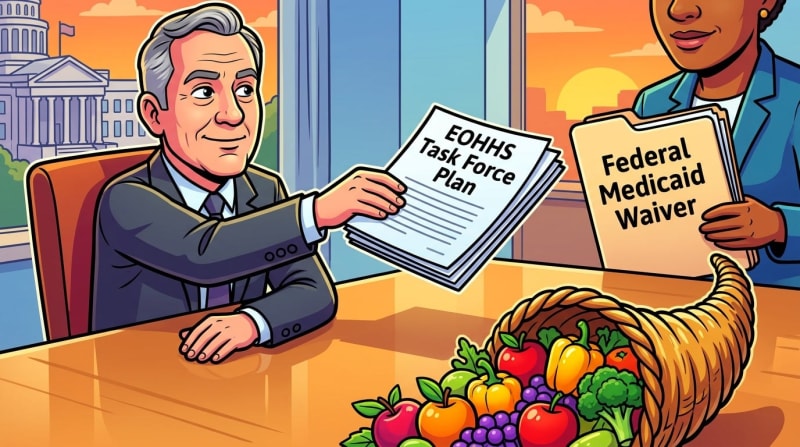
What House Bill 8171 Actually Creates
The law does three things, each reinforcing the others.
First, it establishes a task force administered by the Executive Office of Health and Human Services (EOHHS) to design a Food as Medicine pilot program. The task force carries an active mandate to develop the program structure, not simply recommend one.
Second, EOHHS is explicitly authorized to seek a federal Section 1115 Medicaid waiver to fund nutrition supports. That authorization changes the program's durability entirely. Grant-funded food programs run until the grant runs out. A Medicaid waiver creates a reimbursement stream inside the state's existing infrastructure — the kind of funding that sustains a program across administrations.
The task force and the waiver authority appear together by design. The task force generates the evidence base and program structure; the waiver authority gives that structure a federal funding mechanism to grow into.
Why the 1115 Waiver Path Is Both Promising and Newly Complicated

Why the 1115 Waiver Path Is Both Promising and Newly Complicated
Rhode Island is joining a crowded and active field. According to Harvard's Center for Health Law and Policy Innovation, 23 states are currently using Section 1115 demonstrations to address health-related social needs, with nutrition and housing the most common uses. Rhode Island's legislature looked at what those states were building and gave EOHHS the statutory authority to join them.
The timing is more complicated than the vote count suggests. In June 2026 — the same month HB 8171 was signed — CMS issued guidance implementing new budget neutrality requirements for 1115 waivers under H.R. 1, introducing additional administrative and financial pressure for any state using a waiver to fund nutrition or housing supports. Rhode Island's task force will design its waiver application into this changed environment.
That's not a reason to slow down. It's a reason to be precise about program design from the start — the new CMS requirements reward specificity over ambition.
What Other States Can Learn from Rhode Island's Legislative Approach

What Other States Can Learn from Rhode Island's Legislative Approach
Rhode Island's law packages three elements that state FIM advocates rarely see together in a single piece of legislation: a dedicated task force, an active pilot program mandate, and explicit federal waiver authority. Most states get one or two. The full set is more powerful because each element covers what the others leave open.
For state officers working to advance similar bills, HB 8171 is a concrete template for what codified Food as Medicine authority looks like in statute — not aspirational language, but an administering agency, a task force, and a federal funding pathway named in law.
Rhode Island's task force appointments and waiver application timeline are worth watching over the next 12 to 18 months. That's where legislative intent becomes Medicaid program change — and where the real lessons for other states will be written.
Content ID: mw5n1Zn08nqdnygBnIAmqWkw
See an error? Tell us.
Keep Reading

What North Carolina's New Food Is Medicine Coalition Reveals About Building State Coalitions from Scratch
What the New FIMC Multi-State Evidence Report Reveals About FIM Cost Savings — and Why High-Acuity Patients Are the Key

Child Care Is the Largest Untapped FIM Delivery Platform — A New Report Shows What's Missing
Comments
Share with the Community