
Your Gut Is Telling Your Brain to Eat Protein — What a New Study Found
The Short Version
- A peptide called DH44 triggers protein-seeking behavior when gut cells detect low amino acids — the first identified molecular mechanism for why protein cravings exist.
- Protein cravings after a carb-heavy meal aren't a willpower failure — your gut's amino acid sensors may not have registered what they needed, and the signal keeps running.
- A high-protein breakfast (~35g) was linked to roughly 60% less evening snacking compared to skipping breakfast entirely, according to research published in the journal Obesity.
- The DH44 study was done in model organisms, not humans — but it aligns with a large body of established gut-brain axis research, including the science behind GLP-1 appetite drugs.
- Front-loading protein early in a meal, especially at breakfast, gives your gut's amino acid sensors earlier contact with what they're monitoring — and appears to reduce cravings later in the day.
There is a moment many of us know. You finish a plate of pasta, or toast, or a bowl of granola — a perfectly good meal — and an hour later you're back in the kitchen. Not exactly hungry. But not satisfied either. Hunting for something. You can't always name what you want, but it usually turns out to be eggs, or yogurt, or leftover chicken.
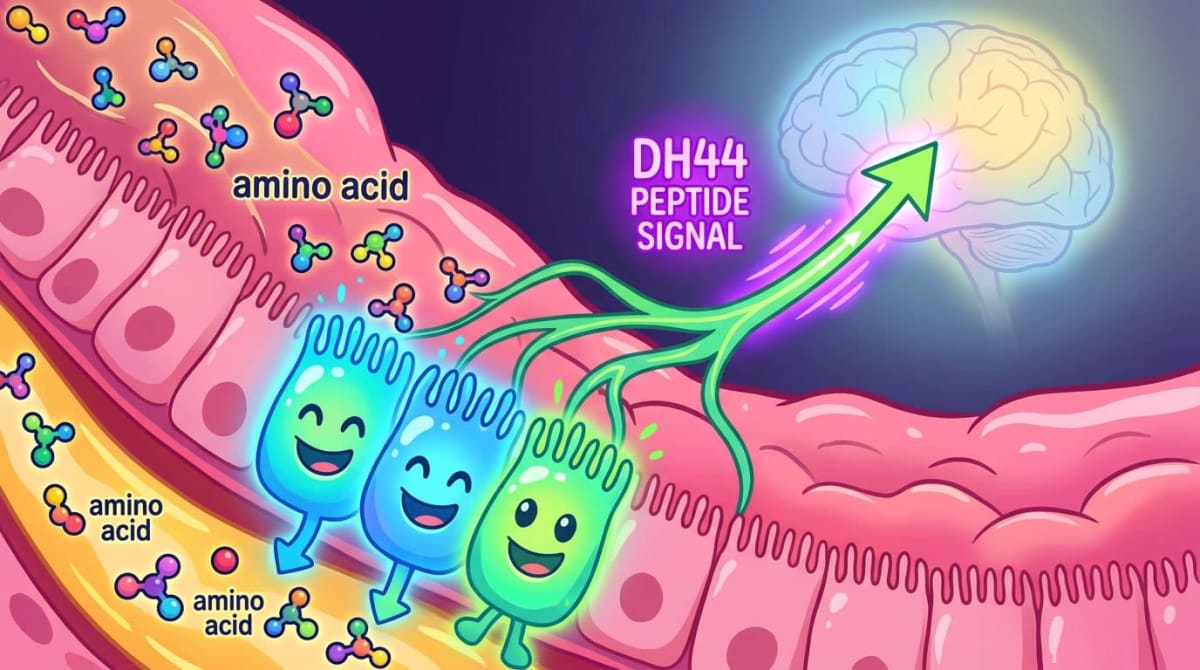
A study published in late May 2026 offers a direct look at how gut brain protein cravings work — and the answer starts not in your mind, but in your digestive tract. Scientists identified a specific biological mechanism by which your gut detects amino acid levels in real time and sends a signal to your brain to go find protein. Not more food generally. Protein specifically.
The Discovery: Your Gut Has a Protein Sensor

The Discovery: Your Gut Has a Protein Sensor
Your gut has been quietly underestimated. For most of modern nutrition history, it was treated primarily as a processing system — something that took in food, extracted nutrients, and moved the rest along. New research is revising that picture significantly.
Research covered by ScienceDaily in May 2026 describes how specialized gut cells function as continuous monitors of amino acid levels — the building blocks of protein — as food passes through your digestive system. When those levels drop, the gut doesn't passively wait. It acts. The mechanism identified in this research involves a peptide called DH44, which elevates protein-seeking behavior when amino acid levels fall below what the body considers adequate. The researchers described the implication directly:
"Our gut is not simply a digestive organ, but an active sensory system that continuously monitors nutritional state and directly guides behavioral decisions."
This represents the first time a specific signaling molecule has been identified as the mechanism behind protein cravings — not a general hunger signal, but a targeted one. The body isn't just asking for more food. It's asking for a specific nutrient class.
The thermic effect of protein gives one signal of how differently the body treats it compared to other macronutrients. While fat costs the body almost nothing to digest, and carbohydrates require modest metabolic energy, protein demands significantly more processing work.
Your body works harder to process protein — and as this new research suggests, it monitors the supply more actively too. Protein isn't just another calorie source. It appears to be the macronutrient your gut tracks with particular attention.
The Gut-Brain Link Behind Protein Cravings

The Gut-Brain Link Behind Protein Cravings
The implications for how we understand food cravings are significant. The dominant cultural narrative around cravings has long been a moral one: you give in because you lack discipline. You reach for the extra serving because you didn't try hard enough. The diet industry has been built, in part, on this story.
What this research describes is meaningfully different. When your gut detects insufficient amino acids and releases a signal toward your brain, the protein craving you feel isn't a character flaw. It's a response from a sensory system doing precisely what it evolved to do. The gut is not misbehaving. It is communicating.
This also explains a specific pattern many people recognize but rarely understand. After a high-carbohydrate meal — pasta, white rice, a stack of pancakes — you might feel full initially, then find yourself craving something more substantial within the hour or two that follows. The carbohydrates satisfied your energy needs, but your gut's amino acid sensors may not have registered what they were looking for. The signal to seek protein didn't go quiet just because the meal happened.
This kind of protein craving is meaningfully different from emotional eating or habit-based cravings. Emotional eating typically centers on specific foods tied to comfort, memory, or stress — the craving is for a category of experience, not a particular macronutrient. What the gut-sensor research describes is something more targeted: the body detecting a nutritional gap and requesting a specific nutrient class, much the way thirst is a response to dehydration rather than evidence of weak character.
The satiety research reinforces this. Holt et al.'s landmark 1995 study established a Satiety Index for common foods — measured against white bread as a baseline — that captures how well different foods satisfy hunger over the two hours after eating. Protein-rich foods consistently score high.
Protein-rich foods produce a qualitatively different fullness signal than refined carbohydrates. You're not imagining it when a meal anchored in protein feels more settling than one that isn't. The body has multiple systems — hormonal, mechanical, neurological — designed to register protein's presence. Your gut may be the one sending the opening signal.
What shifts when you understand this? The most useful question when you're hunting in the kitchen an hour after dinner isn't "why can't I stop?" It's: "did this meal give my gut what it was looking for?"
The Practical Takeaway for Your Plate

The Practical Takeaway for Your Plate
Here is where the research becomes genuinely useful in daily life. If protein cravings are driven by a gut sensor monitoring amino acid levels continuously, then the most direct approach isn't to fight cravings when they arrive — it's to give the sensor what it needs before the signal has to escalate.
Front-loading protein early in a meal appears to matter. Eating protein alongside or before carbohydrates — rather than as an afterthought — gives the gut's sensors earlier contact with amino acids. What they encounter at the beginning of a meal influences the satiety signals that follow.
Breakfast protein may be the most well-supported version of this principle in the research literature. A study published in the journal Obesity found that participants who ate a high-protein breakfast consumed significantly fewer calories from evening snacking than those who ate a normal-protein breakfast or skipped the meal entirely. The afternoon and evening protein cravings that so often reshape a day's intentions didn't escalate in the same way when the morning started with adequate protein.
Thirty-five grams of protein at breakfast sounds significant until you consider what it actually looks like on a plate. Two eggs plus Greek yogurt and a small handful of almonds. Cottage cheese with fruit and a drizzle of honey. Smoked salmon with cream cheese on whole grain toast. These aren't elaborate meals. They're just meals designed with the gut sensor in mind.
The broader satiety cascade is worth understanding. Protein produces the most sustained fullness signals, but fiber and fat each play a supporting role. Fiber slows digestion and feeds the gut microbiome in ways that influence the broader hormonal environment, including natural GLP-1 production. Fat slows gastric emptying, giving satiety signals more time to register before the meal has technically finished. The combination that tends to work best: protein and fiber as the meal's structural anchor, fat as a natural presence in whole foods rather than a separate addition.
None of this is a formula to follow rigidly. It's a framework for understanding why some meals land and others don't — why the same number of calories can leave you satisfied at noon and searching at ten o'clock at night.
What Researchers Say Comes Next

What Researchers Say Comes Next
It's worth being honest about what this study does and doesn't tell us. The DH44 research was conducted in model organisms — not in humans — and while the gut-brain axis mechanisms it describes are consistent with a large body of established research, the specific DH44 pathway has not yet been confirmed to operate identically in human physiology. This is normal for mechanistic nutrition research. Model organism studies are how the field identifies precise mechanisms before moving to clinical trials.
The human-relevant research on gut-brain appetite signaling is substantial and continues to expand. Studies published in journals including Cell Metabolism have established that the gut communicates with the brain continuously through multiple pathways — hormones released by enteroendocrine cells, the vagus nerve, the enteric nervous system — and that this communication shapes not just hunger but food preferences, mood, and metabolic function over time.
The DH44 pathway also connects to one of the most actively researched areas in appetite science: GLP-1. Glucagon-like peptide-1 is a hormone released by gut cells in response to food — particularly protein and fiber — that signals the brain to reduce appetite. The receptor-level mechanisms differ from DH44, but both represent the same broader principle: your gut is an active participant in deciding when and what you eat. The appetite-suppressing effects of GLP-1 agonist drugs are, in a sense, a pharmaceutical amplification of a signal your gut already sends.
What the DH44 study adds is a piece of the puzzle on the upstream side: not just how the gut signals "stop eating," but how it signals "go find protein." Understanding the full circuit — seek, eat, register, satisfy — opens the door to more precise questions about why that circuit works better for some people than others.
Researchers studying this space are asking several important follow-on questions. Does a disrupted gut microbiome blunt amino acid sensing — meaning poor gut health could partly explain persistent protein cravings even in people eating enough? Does chronic under-eating protein recalibrate the threshold at which these signals fire? Are some people's gut sensors more or less sensitive due to genetics, age, or prior dietary patterns? These questions will take years to answer properly, but they suggest the gut-brain relationship around protein is more individual and dynamic than any single daily recommendation can capture.
For now, what this research gives us is something relatively simple and practically useful: a biological basis for trusting your body's nutritional signals rather than treating them as obstacles. When you find yourself wanting protein, your gut may be telling your brain something accurate. The craving isn't evidence of failure — it's communication.
What would it mean to treat your protein cravings as information rather than weakness? What would actually change about how you put together a meal?
Content ID: Eob7GVrsZltULUWFZkYmVZBE
See an error? Tell us.
Keep Reading

What North Carolina's New Food Is Medicine Coalition Reveals About Building State Coalitions from Scratch

What the New FIMC Multi-State Evidence Report Reveals About FIM Cost Savings — and Why High-Acuity Patients Are the Key

Child Care Is the Largest Untapped FIM Delivery Platform — A New Report Shows What's Missing
Comments
Share with the Community