
The 27.6 Million Child Food Is Medicine Program FIM Officers Aren't Tracking and Why H.R. 1 SNAP Cuts Could Unravel It
The Short Version
- CEP serves 27.6 million children in 55,362 schools daily — making it the largest food-is-medicine program in America by an order of magnitude that no produce prescription or medically tailored meal program approaches.
- CEP eligibility depends directly on SNAP participation: when families lose benefits, they stop counting toward a school's Identified Student Percentage, which determines both eligibility and the federal reimbursement rate.
- H.R. 1 SNAP cuts flow through this exact mechanism — reducing ISPs at schools near the eligibility floor, making CEP financially unviable or impossible for some communities to maintain.
- Diet-related conditions cost the United States more than $1.1 trillion annually, and CEP reaches the children most at risk of those conditions every school day at a fraction of the cost of clinical FIM alternatives.
- FIM state officers can act now by mapping which schools in their state are near the CEP eligibility threshold and connecting with school nutrition directors before SNAP cuts translate into program losses.
Every school morning, 27.6 million children walk into a cafeteria and receive a free breakfast or lunch — not because a doctor wrote a prescription, not because a parent filed an application, but because their school participates in the Community Eligibility Provision. That is food is medicine operating at a scale no clinical program has approached. FIM state officers aren't counting it. They should be.
School Meals Have Always Been Food Is Medicine — We Just Didn't Call Them That
School Meals Have Always Been Food Is Medicine — We Just Didn't Call Them That
Diet-related conditions cost Americans more than $1.1 trillion in annual healthcare expenditures, according to a July 2026 framework brief from the Center for Health Care Strategies. That number is the engine behind the entire FIM policy conversation — the produce prescriptions, the medically tailored meal pilots, the Medicaid food-benefit proposals circulating in state capitols right now. All of those programs are valuable. And none of them approaches, in scale, what happens inside a school cafeteria when a district participates in CEP.
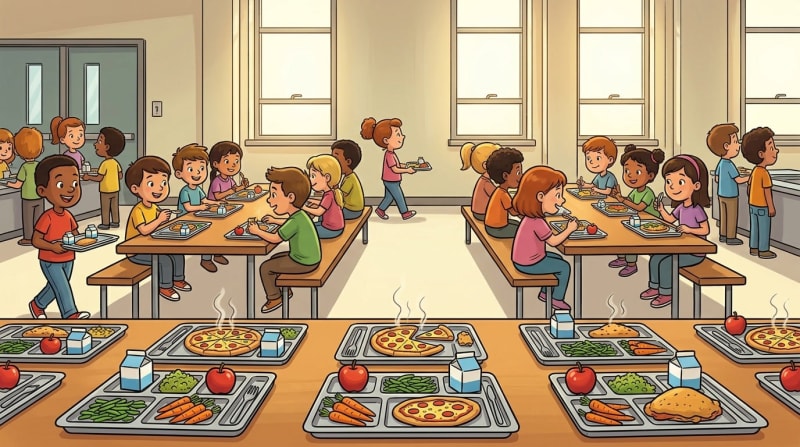
diet-related disease accumulates risk in childhood. Children in CEP-eligible schools are disproportionately from families experiencing food insecurity — the exact population where early nutrition intervention has the greatest documented long-term health impact. A reliable hot meal at breakfast and another at lunch, every school day, is a dietary intervention. It doesn't come with a label that says "food is medicine." But that is exactly what it is.
Here is the CHCS estimate of what diet-related disease costs the United States every year:
The question for FIM advocates is not whether school meals qualify as food is medicine. It is why a program operating at this scale has been largely absent from the FIM policy portfolio — and what it costs us to keep ignoring it.
The Scale No Produce Rx Program Can Touch: 27.6 Million Children

The Scale No Produce Rx Program Can Touch: 27.6 Million Children
According to FRAC's July 22, 2026 report, a record 55,362 schools offered free breakfast and lunch to all their students through CEP during the 2025-2026 school year — serving 27.6 million children, 386,019 more than the prior year. An additional 1,128 schools joined CEP in 2025-2026, representing a 2.1 percent increase from the prior school year.
For context: the produce prescription programs, medically tailored meal pilots, and other clinical food-is-medicine interventions that receive the most attention in FIM policy circles serve populations measured in the hundreds of thousands — at most a few million combined nationally. The CEP's 27.6 million is not a comparable number in the same tier. It is categorically different in scale, and that difference deserves to be at the center of how we frame FIM ambition at the federal level.
Here is how the number of children served has grown year over year:
And the schools participating:
That growth reflects years of deliberate work by school nutrition directors, state advocates, and organizations like FRAC pushing to expand universal school meals. Communities discovered what was already possible. The infrastructure they built is now at risk — not because the need disappeared, but because a policy change in a different program is pulling the foundation out from underneath.
The SNAP-CEP Eligibility Mechanism Every FIM Officer Needs to Know
The SNAP-CEP Eligibility Mechanism Every FIM Officer Needs to Know
CEP's eligibility structure is worth understanding precisely, because the threat to it is structural.
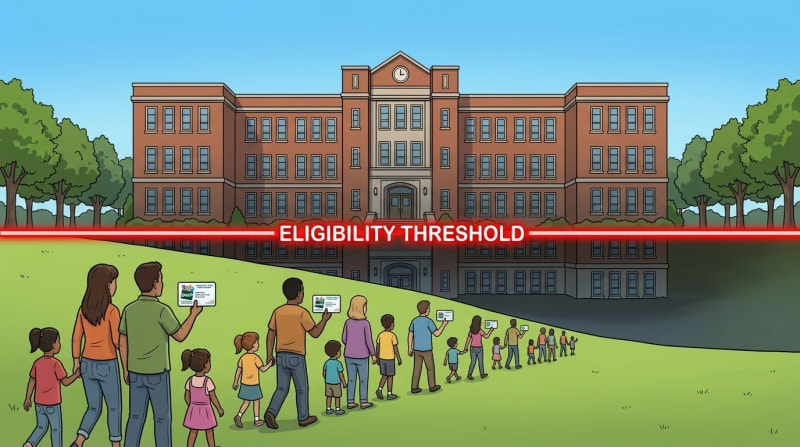
Schools participate in CEP based on their Identified Student Percentage — the share of enrolled students who can be automatically certified for free meals through participation in SNAP, Medicaid direct certification, foster care, homelessness, or similar federal programs. Schools that meet the minimum eligibility threshold set by USDA Food and Nutrition Service can join CEP and offer universal free meals to every child. The federal reimbursement formula is tied directly to this percentage: as the ISP rises, the school receives more federal support for the cost of the program.
This creates a direct dependency on SNAP participation as a data input. When families lose SNAP benefits, they stop counting toward a school's ISP. The ISP drops. The reimbursement rate drops with it. At some point, maintaining CEP becomes financially untenable — or the school falls below the eligibility floor and loses the program entirely.
FRAC documented this clearly in its July 23, 2026 analysis: drops in SNAP participation can have significant consequences for schools' ability to maintain the CEP program.
This is the chain of causation FIM state officers need to understand. A school community that sits comfortably above the CEP eligibility floor today could find itself precariously close — or below it — after a significant reduction in local SNAP caseloads. The eligibility floor doesn't move when federal benefit policy changes. The community's data does.
What H.R. 1 Actually Does to School Meal Eligibility

What H.R. 1 Actually Does to School Meal Eligibility
H.R. 1 enacted deep cuts to SNAP, causing millions of people to lose nutrition assistance benefits or receive reduced amounts. Those losses flow directly into the CEP eligibility calculations described above. As FRAC reported in July 2026, schools could lose eligibility for CEP or find that it is no longer financially viable to participate as community SNAP caseloads shrink.
The mechanism is arithmetic, not metaphor. Fewer SNAP participants in a school's community means a lower ISP. A lower ISP means a lower federal reimbursement rate. Below the eligibility floor, the school loses CEP entirely. The school that invested years building a universal meal program — eliminating the stigma of the lunch line, removing the daily administrative burden on families — now faces the prospect of dismantling it. Not because the need disappeared. Because the eligibility scaffolding underneath was removed by a policy change in a different program.
FRAC President Crystal FitzSimons was direct about what is at stake in the July 2026 announcement:
"Without congressional action to reverse the SNAP cuts, children will lose critical food benefits that help families keep hunger at bay, and the progress we have made on Healthy School Meals for All could unravel."
— Crystal FitzSimons, FRAC President, July 22, 2026
That is not a worst-case scenario. It is the predictable output of the eligibility mechanism: if SNAP caseloads drop, ISP drops, reimbursement drops, and the program serving 27.6 million children every school day starts to fray at the edges — one school at a time.
What FIM State Officers Should Do: Connect the School Meals System to Your Portfolio
What FIM State Officers Should Do: Connect the School Meals System to Your Portfolio
The path forward starts with a framing shift: CEP is not a school nutrition program adjacent to the FIM portfolio. It is the largest food-as-medicine program in the country, and it is now threatened by the same federal policy wave that FIM advocates are already fighting.
Treat CEP advocacy as part of the FIM state officer mandate. This is not a separate school nutrition issue — it is the same food-is-medicine argument operating at a different scale. Connect with state school nutrition directors to map which schools in your state are near the CEP eligibility threshold and model the SNAP-cut impact before it arrives. This is exactly the upstream data work FIM officers are well positioned to do, and that school nutrition administrators often lack the bandwidth to pursue on their own.
Support the Healthy School Meals for All federal framework as the structural fix. The fundamental vulnerability of CEP is its dependency on SNAP participation as an eligibility proxy. Healthy School Meals for All removes that dependency by making universal free school meals a federal commitment — not a calculation that recalibrates every time a different benefit program is cut. That is the long-term solution worth pushing for — not as a school nutrition priority, but as food-is-medicine infrastructure.
The children in CEP schools didn't ask to be a food-is-medicine intervention. They showed up for breakfast. The question is whether FIM policy will show up for them — by treating the threat to 27.6 million daily meals as the food-as-medicine emergency it is.
Content ID: AGHvFbVObFdeCRsXQb8VsORW
See an error? Tell us.
Keep Reading

What North Carolina's New Food Is Medicine Coalition Reveals About Building State Coalitions from Scratch
What the New FIMC Multi-State Evidence Report Reveals About FIM Cost Savings — and Why High-Acuity Patients Are the Key
Child Care Is the Largest Untapped FIM Delivery Platform — A New Report Shows What's Missing
Comments
Share with the Community